
Type-B and Type-C are not generic industry grades. They are two named XCCOLD product variants within the plug-in, glass-door, bottom-compressor upright family. A buyer should therefore compare the exact product pages and quotation data rather than assuming that “C” is universally larger, colder or more efficient than “B.”
Both variants put the refrigeration package at the bottom of an upright glass-door cabinet. The current product intelligence distinguishes Type-C by a pull-out compressor tray intended to improve maintenance access. That difference is useful only when the selected model, service direction and site clearance are confirmed on the approved drawing.
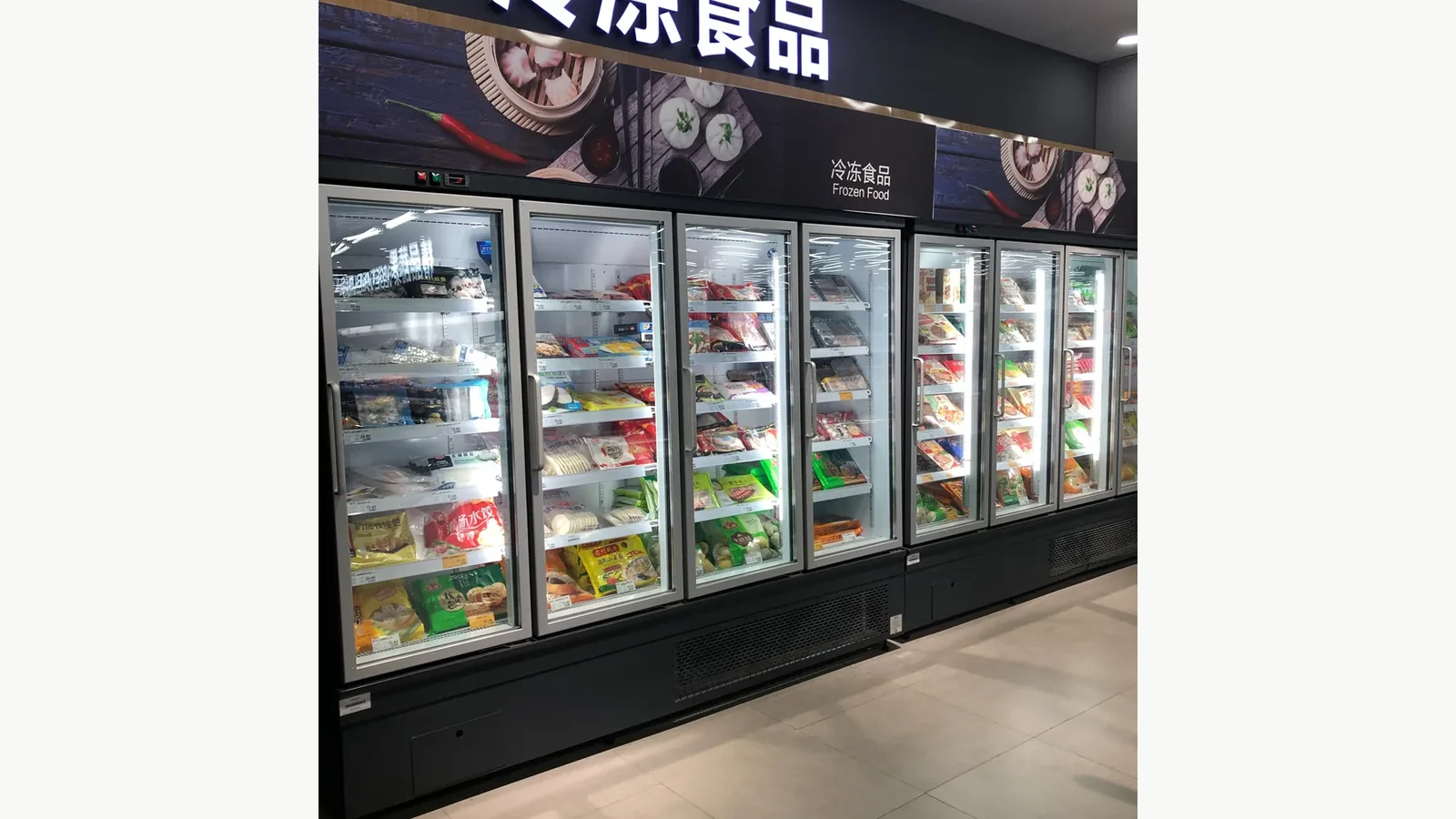
Compare Exact Variants, Not the Letters Alone
Begin the quotation with two traceable product lines:
| Comparison field | Type-B | Type-C |
|---|---|---|
| Exact product | Plug-in bottom-compressor glass-door Type-B | Plug-in bottom-compressor glass-door Type-C |
| Product family | Glass-door upright chiller/freezer | Glass-door upright chiller/freezer |
| System arrangement | Plug-in/self-contained, bottom compressor | Plug-in/self-contained, bottom compressor |
| Recorded distinction | Standard Type-B variant; exact maintenance arrangement requires current drawing | Product record identifies a pull-out compressor tray for easier maintenance |
| Approval basis | Exact SKU, duty, options and drawing | Exact SKU, duty, tray arrangement, options and drawing |
The family includes chilled and frozen duties by model. A temperature from one variant, photograph or category description cannot be transferred to another SKU. State the merchandise and required operating condition, then ask XCCOLD to identify the exact chiller or freezer model and return its verified schedule.
Turn “Easy Maintenance” Into a Clearance Drawing
A pull-out tray is not useful if a plinth, wall return, bollard, checkout, stock trolley or adjacent cabinet blocks its path. Ask for a service view showing which panel opens, the direction and distance of tray movement, isolation steps, cable or pipe constraints, and the working area required by a qualified technician.
For Type-B, request the same service-access evidence even if the mechanism is different. The buyer needs to know how the condensing section is reached, what routine cleaning access is required and which parts can be removed without moving the whole cabinet. Compare the returned drawings on the store plan.
Useful hold points include:
- front clearance with doors closed and open;
- compressor-compartment access direction;
- pull-out or removal path, if applicable;
- clearance from skirting, curbs, guard rails and adjacent joinery;
- access to condenser cleaning points and controls;
- route for a technician, tools and removed panels;
- safe electrical isolation location;
- floor condition and levelling requirement from the exact manual.
The published article on top-light-box versus bottom-compressor glass-door cabinets explains the broader structural choice. Once the project has selected a bottom-compressor family, the Type-B/Type-C decision should move to the narrower service mechanism and exact model schedule covered here.
Freeze the Product Duty Before Comparing Cabinet Details
“Glass-door cooler/freezer” is a family label, not permission to use one cabinet for every product. Write a merchandise schedule that separates chilled beverages, dairy, packaged chilled food and frozen products. For each group, state the required operating condition, store ambient design basis and expected loading or replenishment pattern.
The supplier should then return the exact model, verified operating range and project data needed by the refrigeration and electrical designers. Keep chilled and frozen variants on separate lines even when their external photographs are similar. Glass heating, defrost, controls, power and internal arrangements can differ; only exact documentation can confirm what applies.
Avoid converting a catalogue phrase into a performance guarantee. Final selection depends on the declared duty, ambient conditions, loading, door-opening pattern, installation, ventilation and commissioning. The quotation should show which assumptions were used and which data remains provisional.
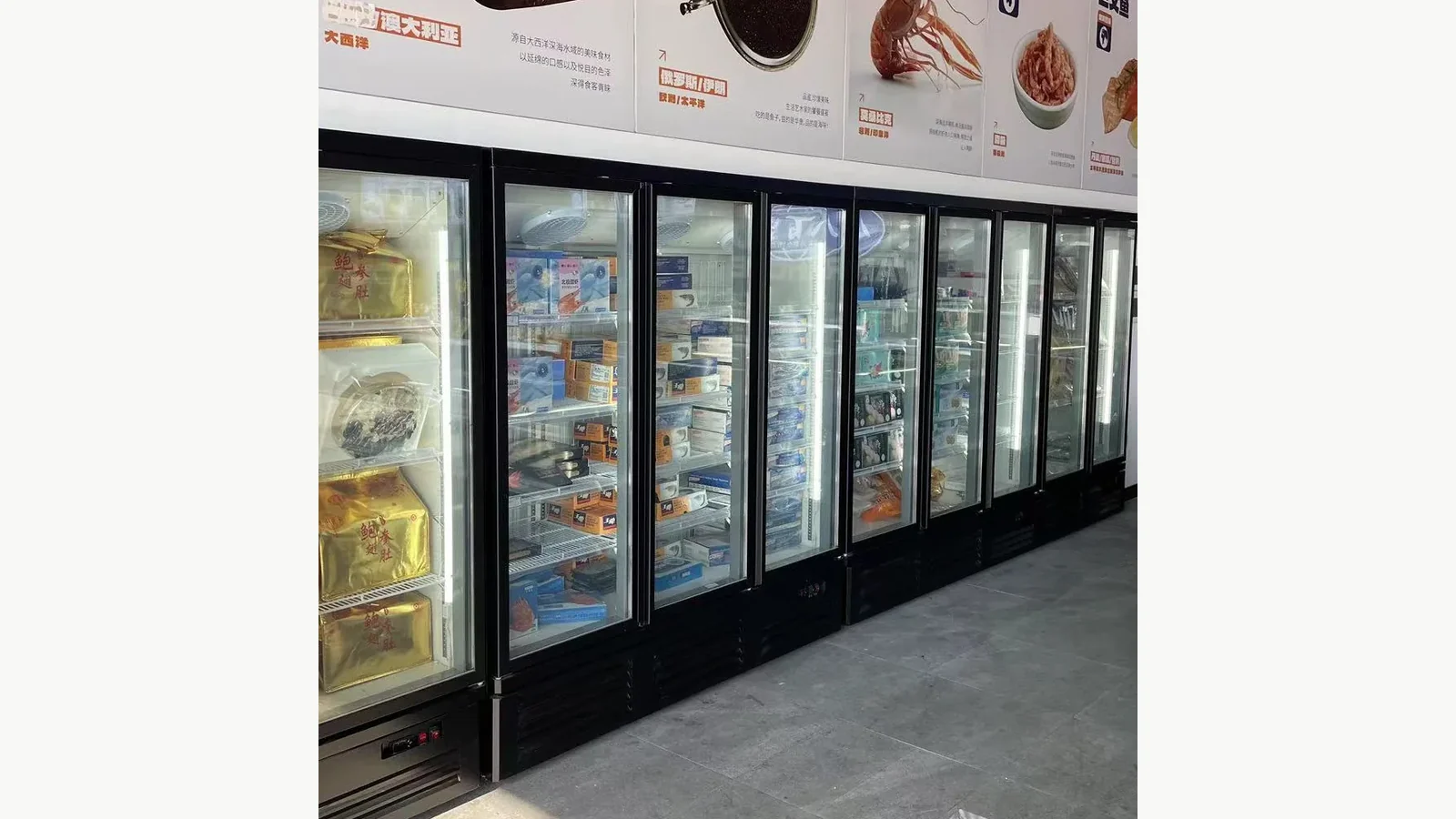
Check the Cabinet Drawing and Store Interfaces
Request a plan, front elevation and section for the proposed Type-B and Type-C SKUs. Compare external width, depth and height; door count and swing; shelf arrangement; compressor-section height; ventilation openings; service panels; casters or feet; electrical entry; drainage if applicable; and any top or side clearance named by the manufacturer.
The dimension drawing below is not a universal Type-B/Type-C size. It is an exact product-page reference showing why the lower machinery section and cabinet profile must be coordinated. The final purchase order needs the drawing revision for the actual SKU.
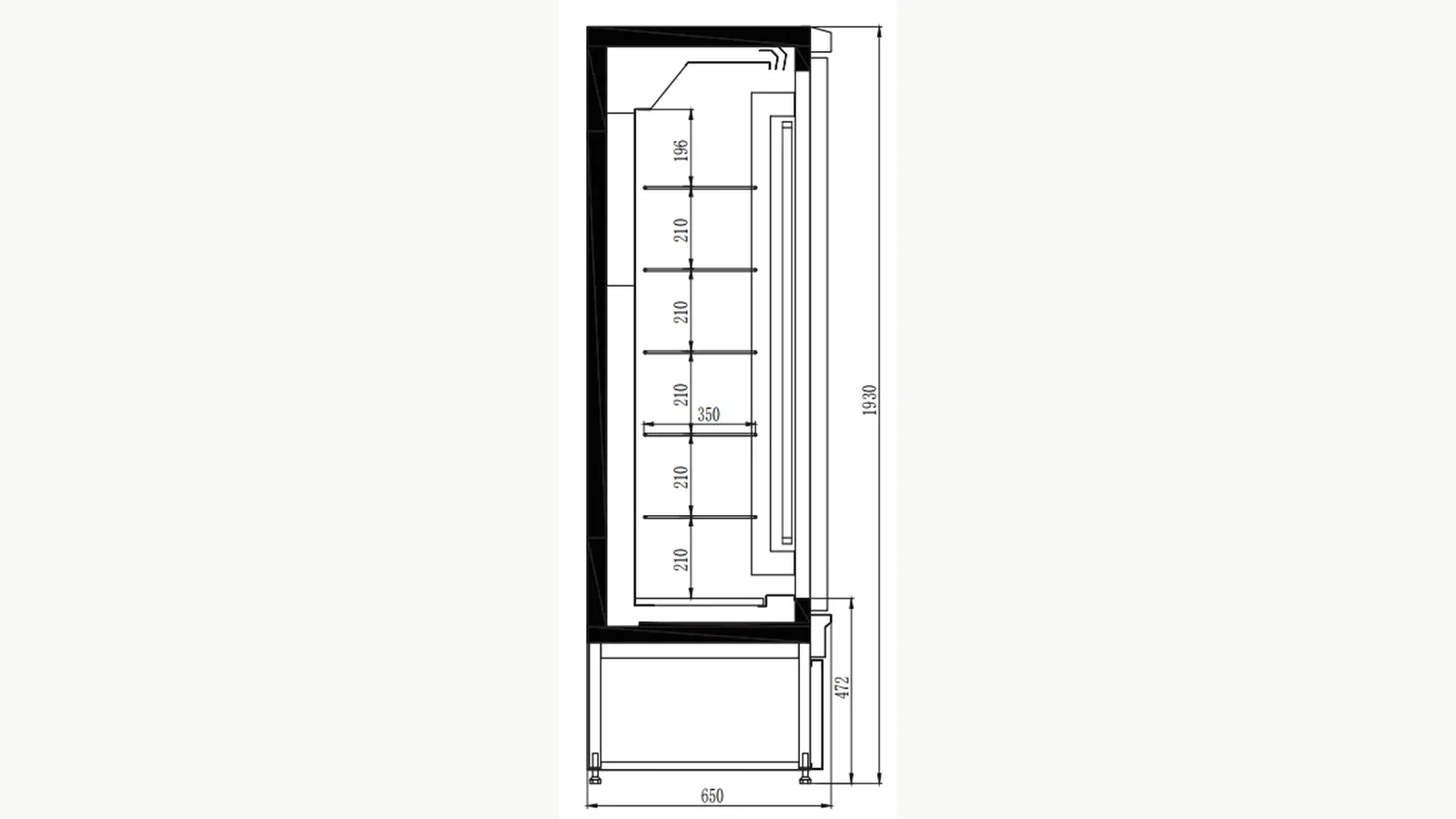
Overlay the approved model on the real store plan. Mark aisle clearance, door swing, replenishment route, customer reach, electrical point, floor slope, nearby heat sources and service approach. If cabinets form a lineup, show end panels and the access consequence at both ends.
The service plan should survive normal store operation. A technician should not need to dismantle permanent joinery or block an emergency route because the tender drawing omitted the compressor access zone. Likewise, a clear sales-floor photograph does not prove that the rear, underside or electrical interface is accessible.
Compare Quotes With an Evidence Matrix
Send both bidders—or both XCCOLD options—the same return schedule. Require one of four statuses for each line: confirmed, optional, excluded or pending project data.
| Return item | Evidence to request |
|---|---|
| Exact identity | Product title, model/SKU and product-page URL |
| Duty | Chiller/freezer designation and verified operating schedule |
| Cabinet | Approved dimensions, doors, shelves and finish |
| Refrigeration package | Location, ventilation and service arrangement |
| Type-C tray | Drawing or manual showing the actual pull-out mechanism and access |
| Electrical | Nameplate/schedule for voltage, frequency, phase, power and plug or connection |
| Site interfaces | Required clearances, floor, drainage and ambient assumptions |
| Options | Itemised inclusions rather than “standard accessories” |
| Delivery | Packing dimensions, weights, route limits and positioning scope |
| Handover | Manuals, settings, test records, spares, training and warranty terms |
Price differences can then be traced to a model, feature or scope line. A lower quote is not comparable if it omits the service tray, uses a chilled model where frozen duty is required, or leaves delivery and commissioning undefined.
Inspect the Selected Cabinet Before Release
For a sample or first unit, check the model plate against the order, then compare door count, cabinet finish, shelf set, lighting, controls, lower-panel arrangement and supplied accessories with the approved schedule. For Type-C, operate or inspect the pull-out arrangement only under the supplier's safe procedure and with qualified personnel. Record whether the required service path exists; a loaded or connected assembly must never be forced.
Use photographs with the cabinet ID and revision. If the unit differs from the approved drawing, quarantine the decision and obtain written disposition. A factory image that resembles the cabinet cannot replace the exact nameplate and inspection record.
The later site handover should also record installation position, electrical connection, commissioning data, controller settings, door operation and service clearances. Those records make future maintenance far easier than relying on the “Type-B” or “Type-C” label alone.
Send an RFQ That Produces a Defensible Choice
Provide store location and ambient design basis, merchandise and duty, desired door count, available footprint, door-swing limits, replenishment route, electrical supply information, delivery path and service-side constraints. Attach the marked plan and request Type-B and Type-C as separate priced lines.
The CTA is to return two exact model schedules with drawings, service-access evidence, electrical data, options, exclusions and lead time. Choose the variant whose verified configuration fits the operating duty and the real maintenance path—not the one whose letter appears newer.