
A deli service run is not one long generic counter. It is a sequence of identified cabinets with straight front glass, prepared-food display areas, exposed or joined ends, rear-service access, and project-specific tray or pan arrangements. If packages arrive or installers begin from an unnumbered layout, modules can be reversed and a wrong end treatment can remain hidden until the final bay. This article stays within the straight-glass deli-food showcase category. Curved-glass deli counters and fresh-meat showcases are separate visual and product entities.
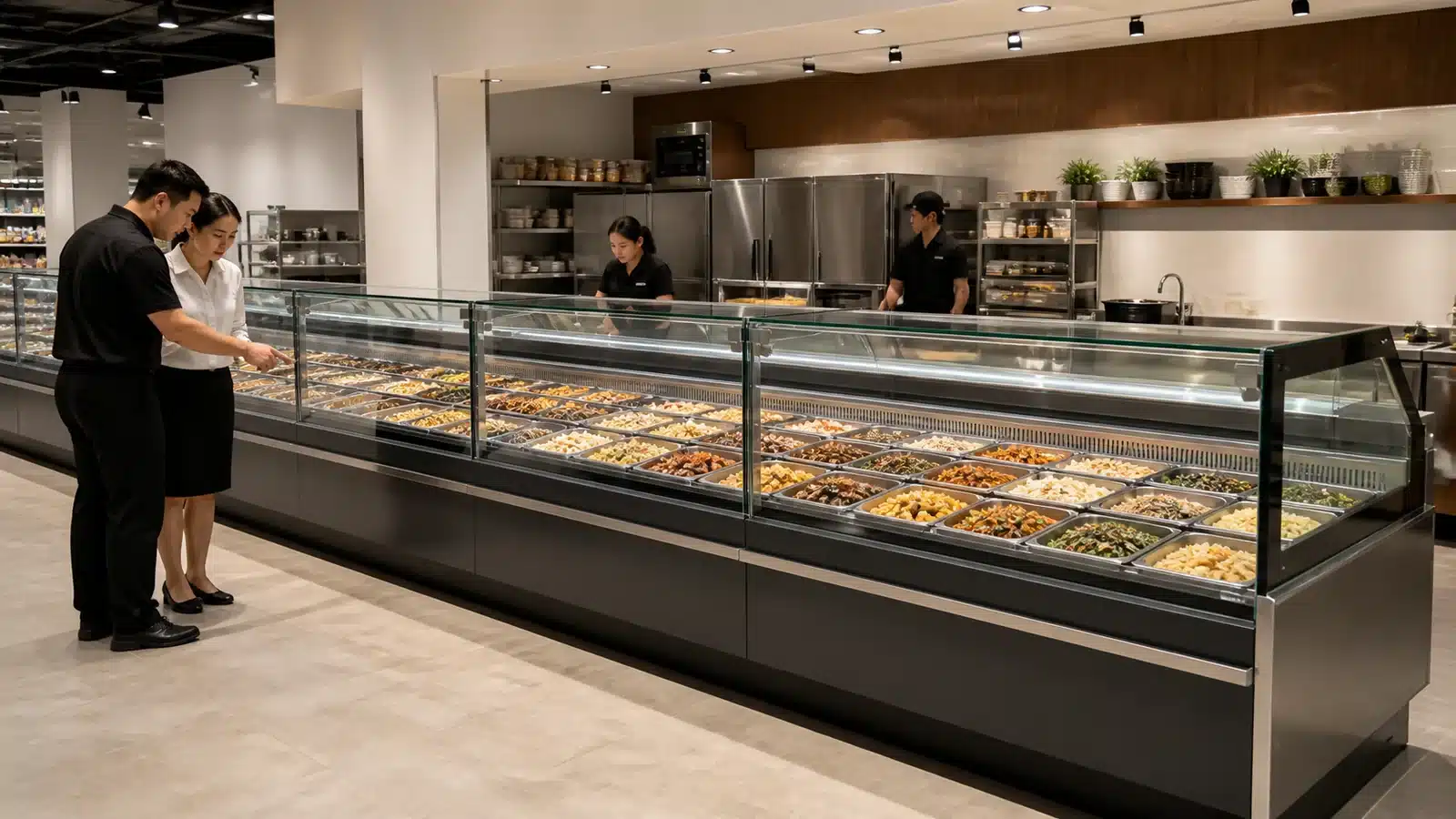
Create a Cabinet-by-Cabinet Lineup Schedule
every straight-glass deli showcase has a unique position, model, handed relation, application, and exposed or joined end. For this straight glass deli showcase lineup sequence joints task, the responsible team should number cabinets from a stated store-plan origin and connect each ID to drawing, order line, package, and installation mark. The check belongs at the point where the physical condition and its identity can still be verified together.
At the create a cabinet-by-cabinet lineup schedule stage, retain lineup plan, cabinet schedule, product title, model, length only from approved documents, end condition, and revision. Link each photograph, count, mark, drawing, or note to the straight glass deli showcase lineup sequence joints item it describes, including the current location and responsible role where those facts matter.
Total run length cannot identify module order. That boundary governs straight glass deli showcase lineup sequence joints, not a different product or site. When evidence supports more than one interpretation, record the uncertainty and route it to the qualified decision owner.
Close create a cabinet-by-cabinet lineup schedule only when buyer, supplier, and installer share the same sequence. If open, preserve the straight glass deli showcase lineup sequence joints state and name the unresolved point, owner, next evidence, and hold or follow-up action before physical custody or project work changes.
Before moving on, compare lineup plan, cabinet schedule, product title, model, length only from approved documents, end condition, and revision with the release condition: buyer, supplier, and installer share the same sequence. This final comparison gives the straight glass deli showcase lineup sequence joints handoff enough context for the next buyer, supplier, warehouse, installer, operator, or project reviewer to act without rebuilding the chronology.
Approve the Straight Glass Line
front glass height, angle or exact straight form, top profile, counter edge, and visual joint follow the selected models rather than a mixed reference set. For this straight glass deli showcase lineup sequence joints task, the responsible team should review the elevation across every module and enlarge each glass-to-glass or glass-to-end transition. The check belongs at the point where the physical condition and its identity can still be verified together.
At the approve the straight glass line stage, retain approved elevation, first-joint detail, finish samples, module IDs, sightline, and unresolved interface. Link each photograph, count, mark, drawing, or note to the straight glass deli showcase lineup sequence joints item it describes, including the current location and responsible role where those facts matter.
A curved-glass image or module cannot fill a straight-glass project gap. That boundary governs straight glass deli showcase lineup sequence joints, not a different product or site. When evidence supports more than one interpretation, record the uncertainty and route it to the qualified decision owner.
Close approve the straight glass line only when the visible front line has structure-matched approval. If open, preserve the straight glass deli showcase lineup sequence joints state and name the unresolved point, owner, next evidence, and hold or follow-up action before physical custody or project work changes.
Before moving on, compare approved elevation, first-joint detail, finish samples, module IDs, sightline, and unresolved interface with the release condition: the visible front line has structure-matched approval. This final comparison gives the straight glass deli showcase lineup sequence joints handoff enough context for the next buyer, supplier, warehouse, installer, operator, or project reviewer to act without rebuilding the chronology.
Define Exposed Ends and Joined Ends
each cabinet end is labeled as exposed, wall-adjacent, filler-adjacent, or connected to another released deli module. For this straight glass deli showcase lineup sequence joints task, the responsible team should request the exact end panels, joint kits, trims, and site interfaces available for the selected models. The check belongs at the point where the physical condition and its identity can still be verified together.
At the define exposed ends and joined ends stage, retain end schedule, supplied parts, site-built parts, finish, removable features, neighboring object, and owner. Link each photograph, count, mark, drawing, or note to the straight glass deli showcase lineup sequence joints item it describes, including the current location and responsible role where those facts matter.
An end treatment should not be guessed from the middle of a category photo. That boundary governs straight glass deli showcase lineup sequence joints, not a different product or site. When evidence supports more than one interpretation, record the uncertainty and route it to the qualified decision owner.
Close define exposed ends and joined ends only when every end has a complete commercial and installation scope. If open, preserve the straight glass deli showcase lineup sequence joints state and name the unresolved point, owner, next evidence, and hold or follow-up action before physical custody or project work changes.
Before moving on, compare end schedule, supplied parts, site-built parts, finish, removable features, neighboring object, and owner with the release condition: every end has a complete commercial and installation scope. This final comparison gives the straight glass deli showcase lineup sequence joints handoff enough context for the next buyer, supplier, warehouse, installer, operator, or project reviewer to act without rebuilding the chronology.
Deli Lineup Interface Register
The register keeps visual, display, rear-service, packing, and installation decisions attached to each straight-glass module.
| Review Point | Evidence | Hold or Release Question |
|---|---|---|
| Cabinet position | Module ID, model, order line and package | Is the sequence unambiguous? |
| Front interface | Straight glass line, exposed ends and joints | Does every transition match the structure? |
| Display and service | Prepared-food pans and rear access | Is continuity approved across joints? |
| Installation | Delivery order, first joint and final photos | Does the built run match release? |
Coordinate Prepared-Food Display Continuity
the lineup supports the approved pan or tray arrangement, product grouping, service reach, and changes at cabinet joints. For this straight glass deli showcase lineup sequence joints task, the responsible team should overlay the released container map and rear-service workflow on the cabinet sequence without assuming universal pan sizes. The check belongs at the point where the physical condition and its identity can still be verified together.
At the coordinate prepared-food display continuity stage, retain pan or tray family, module assignment, joint transition, support details, product category, and approved exception. Link each photograph, count, mark, drawing, or note to the straight glass deli showcase lineup sequence joints item it describes, including the current location and responsible role where those facts matter.
Fresh-meat trays and deli-food pans should not be treated as interchangeable because both fit behind glass. That boundary governs straight glass deli showcase lineup sequence joints, not a different product or site. When evidence supports more than one interpretation, record the uncertainty and route it to the qualified decision owner.
Close coordinate prepared-food display continuity only when the prepared-food display plan matches the exact deli modules. If open, preserve the straight glass deli showcase lineup sequence joints state and name the unresolved point, owner, next evidence, and hold or follow-up action before physical custody or project work changes.
Before moving on, compare pan or tray family, module assignment, joint transition, support details, product category, and approved exception with the release condition: the prepared-food display plan matches the exact deli modules. This final comparison gives the straight glass deli showcase lineup sequence joints handoff enough context for the next buyer, supplier, warehouse, installer, operator, or project reviewer to act without rebuilding the chronology.
Protect Rear-Service Continuity
staff routes, rear doors or access features where documented, work surfaces, supports, cleaning boundaries, and service zones continue across joints. For this straight glass deli showcase lineup sequence joints task, the responsible team should walk the rear elevation cabinet by cabinet and mark every change in access, panel, workstation, floor, or neighboring fixture. The check belongs at the point where the physical condition and its identity can still be verified together.
At the protect rear-service continuity stage, retain rear-service elevation, access movement, joint cover, obstruction, cleaning route, model-specific service requirement, and owner. Link each photograph, count, mark, drawing, or note to the straight glass deli showcase lineup sequence joints item it describes, including the current location and responsible role where those facts matter.
Visual front alignment cannot prove that rear functions align. That boundary governs straight glass deli showcase lineup sequence joints, not a different product or site. When evidence supports more than one interpretation, record the uncertainty and route it to the qualified decision owner.
Close protect rear-service continuity only when operations and technical teams accept the full rear interface. If open, preserve the straight glass deli showcase lineup sequence joints state and name the unresolved point, owner, next evidence, and hold or follow-up action before physical custody or project work changes.
Before moving on, compare rear-service elevation, access movement, joint cover, obstruction, cleaning route, model-specific service requirement, and owner with the release condition: operations and technical teams accept the full rear interface. This final comparison gives the straight glass deli showcase lineup sequence joints handoff enough context for the next buyer, supplier, warehouse, installer, operator, or project reviewer to act without rebuilding the chronology.
Pack and Install in the Released Sequence
package IDs and unloading order allow the installation team to place the correct first, middle, and final cabinets without opening every crate for identification. For this straight glass deli showcase lineup sequence joints task, the responsible team should apply cabinet and position codes, issue a package-to-lineup map, verify the first module and first joint, then continue under the approved sequence. The check belongs at the point where the physical condition and its identity can still be verified together.
At the pack and install in the released sequence stage, retain package label, delivery order, route, cabinet condition, installed position, first-joint review, deviation, and final lineup photos. Link each photograph, count, mark, drawing, or note to the straight glass deli showcase lineup sequence joints item it describes, including the current location and responsible role where those facts matter.
Speed at site should not turn a clearly labeled sequence into an improvised order. That boundary governs straight glass deli showcase lineup sequence joints, not a different product or site. When evidence supports more than one interpretation, record the uncertainty and route it to the qualified decision owner.
Close pack and install in the released sequence only when the finished run matches the released plan and each joint closes. If open, preserve the straight glass deli showcase lineup sequence joints state and name the unresolved point, owner, next evidence, and hold or follow-up action before physical custody or project work changes.
Before moving on, compare package label, delivery order, route, cabinet condition, installed position, first-joint review, deviation, and final lineup photos with the release condition: the finished run matches the released plan and each joint closes. This final comparison gives the straight glass deli showcase lineup sequence joints handoff enough context for the next buyer, supplier, warehouse, installer, operator, or project reviewer to act without rebuilding the chronology.
Buyer Checklist
- Number cabinets from a defined plan origin.
- Keep straight-glass deli identity in every reference.
- Label exposed, joined, wall, and filler ends.
- Overlay the approved prepared-food container map.
- Review front and rear continuity separately.
- Map package IDs to installation positions.
- Approve the first joint before repeating the run.
Frequently Asked Questions
Can a straight-glass and curved-glass deli module share one lineup?
Only when the manufacturer and project explicitly design and approve that exact transition. Never infer compatibility from the shared deli category.
Is the total length enough for ordering?
No. The order also needs module models, sequence, handed details, end treatments, joints, display arrangement, rear access, services, finishes, and packaging identity.
Can a fresh-meat showcase image illustrate this article?
No. The application and image entity must remain the straight-glass deli-food showcase with prepared-food context.
Related Product or Reading
Check the exact deli food showcase counter category before releasing cabinet sequence, straight-glass joints, and prepared-food display assumptions.
Discuss the Exact Project
Send XCCOLD the selected straight-glass deli models, cabinet schedule, lineup plan and elevation, exposed ends, joint details, pan map, rear-service layout, finishes, delivery sequence, and site route.