
Produce replenishment begins well before a pack reaches an open chiller shelf. Cases or crates arrive, move through receiving, wait in a backroom zone, transfer to a smaller cart, and enter a customer aisle that may still be trading. Packaging sizes, loose outer materials, water or soil, shelf depth, price rails, rotation rules, and empty-crate return all affect that route.
A crate-to-shelf plan connects the cabinet layout with the store's operating units. It identifies which items arrive in what outer pack, where they are opened, how sellable packs are carried, which shelf zone receives them, and where returns or waste go. The team also preserves the cabinet's documented loading boundaries and records recurring condensation, blockage, or damage for review rather than solving it by adding more stock.
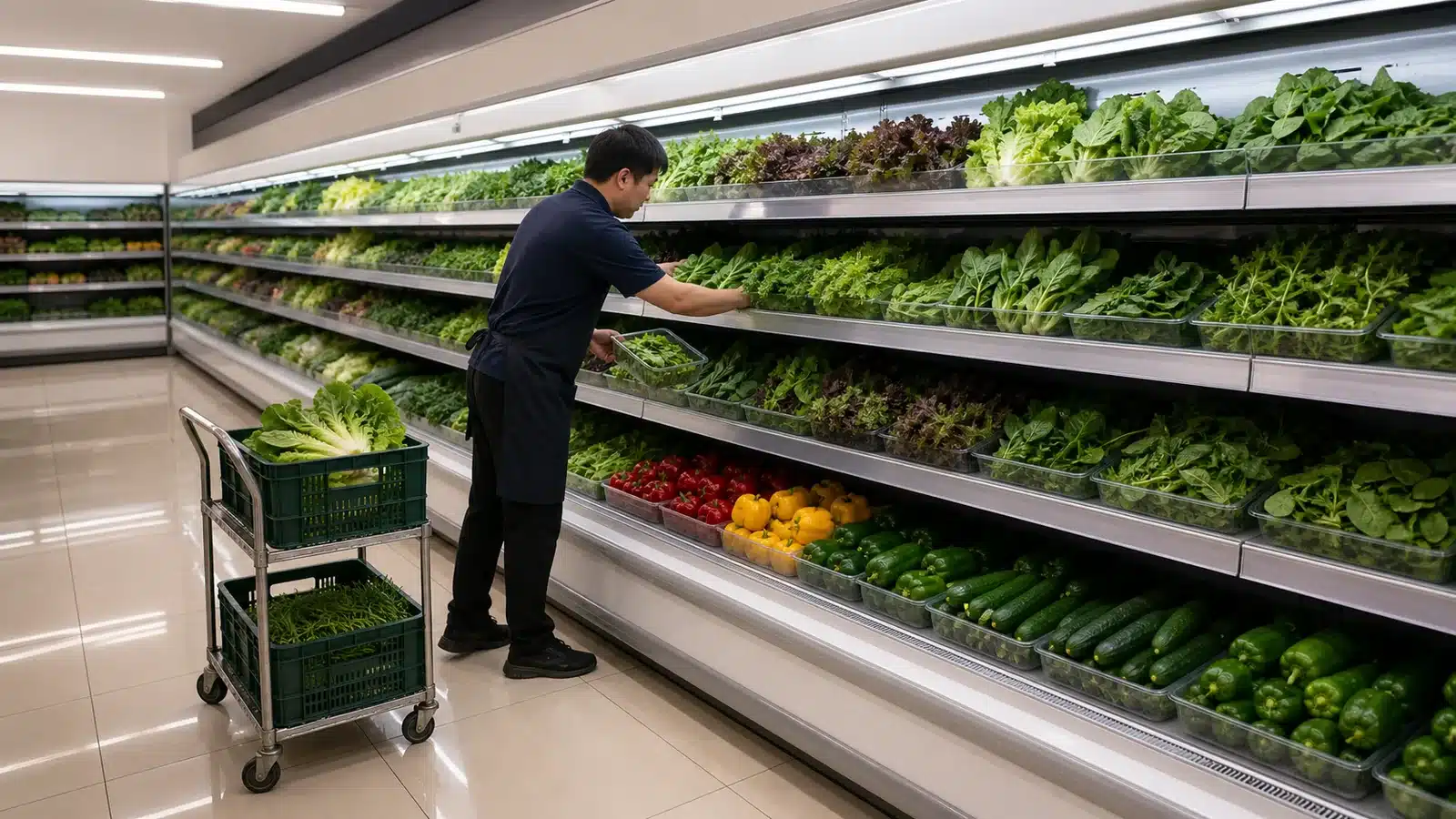
Define the Produce Handling Unit
List how each selected item arrives, is opened, and reaches the shelf. The working record for this stage covers item category, outer case or crate, sellable pack, loose or packaged format, pack dimensions, opening point, and returnable container.
Records for this stage
- item category: source, location, owner, status, and date.
- outer case or crate: source, location, owner, status, and date.
- sellable pack: source, location, owner, status, and date.
- loose or packaged format: source, location, owner, status, and date.
- pack dimensions: source, location, owner, status, and date.
- opening point: source, location, owner, status, and date.
Why this stage can fail: Planning shelf capacity from product names while the outer case and selling pack sizes remain unknown. Use item category, outer case or crate, and sellable pack to document the exception, and keep loose or packaged format with the reviewer's decision.
Release condition: Each item has a documented delivery unit, shelf unit, and handling transition. Record any exception against opening point, name its owner and next action, and keep returnable container open until resolved.
Map Receiving, Staging, and Aisle Movement
Walk the full path with the trolley and crates intended for normal operation. The working record for this stage covers receiving point, backroom slot, preparation table, trolley type, door clearance, aisle turn, and empty-container return.
Records for this stage
- receiving point: source, location, owner, status, and date.
- backroom slot: source, location, owner, status, and date.
- preparation table: source, location, owner, status, and date.
- trolley type: source, location, owner, status, and date.
- door clearance: source, location, owner, status, and date.
- aisle turn: source, location, owner, status, and date.
Why this stage can fail: Drawing a direct line to the cabinet that ignores doors, queues, thresholds, cleaning work, and return traffic. Use receiving point, backroom slot, and preparation table to document the exception, and keep trolley type with the reviewer's decision.
Release condition: The route works in the planned trading window and has a defined staging point that does not block customers. Record any exception against aisle turn, name its owner and next action, and keep empty-container return open until resolved.
Assign Shelf Zones by Pack and Access
Build a shelf map from pack dimensions, staff reach, product visibility, and cabinet loading guidance. The working record for this stage covers shelf number, item family, pack height and depth, facing count, price rail, staff reach, and documented loading boundary.
Records for this stage
- shelf number: source, location, owner, status, and date.
- item family: source, location, owner, status, and date.
- pack height and depth: source, location, owner, status, and date.
- facing count: source, location, owner, status, and date.
- price rail: source, location, owner, status, and date.
- staff reach: source, location, owner, status, and date.
Why this stage can fail: Forcing a promotional quantity into a shelf zone that obstructs the open display path or extends beyond the front edge. Use shelf number, item family, and pack height and depth to document the exception, and keep facing count with the reviewer's decision.
Release condition: Every listed item has a shelf home and remains within the cabinet's approved loading arrangement. Record any exception against staff reach, name its owner and next action, and keep documented loading boundary open until resolved.
Control Rotation and Temporary Removal
Use a clear sequence for older stock, new stock, inspection, and product held aside. The working record for this stage covers delivery identity, display date or store rotation record, older-stock location, new-stock location, damaged pack, held product, and responsible role.
Records for this stage
- delivery identity: source, location, owner, status, and date.
- display date or store rotation record: source, location, owner, status, and date.
- older-stock location: source, location, owner, status, and date.
- new-stock location: source, location, owner, status, and date.
- damaged pack: source, location, owner, status, and date.
- held product: source, location, owner, status, and date.
Why this stage can fail: Mixing new and existing packs during a rushed fill and losing the store's chosen rotation evidence. Use delivery identity, display date or store rotation record, and older-stock location to document the exception, and keep new-stock location with the reviewer's decision.
Release condition: Sellable stock, held stock, waste, and empty packaging follow separate visible routes. Record any exception against held product, name its owner and next action, and keep responsible role open until resolved.
Review Replenishment Effects on the Cabinet
Record repeated spills, debris, shelf movement, blocked paths, condensation observations, and impact marks. The working record for this stage covers cleaning event, drainage observation, shelf displacement, air-path observation, trolley contact, pack debris, and maintenance referral.
Records for this stage
- cleaning event: source, location, owner, status, and date.
- drainage observation: source, location, owner, status, and date.
- shelf displacement: source, location, owner, status, and date.
- air-path observation: source, location, owner, status, and date.
- trolley contact: source, location, owner, status, and date.
- pack debris: source, location, owner, status, and date.
Why this stage can fail: Treating recurring water, blockage, or physical contact as a normal stocking consequence with no escalation. Use cleaning event, drainage observation, and shelf displacement to document the exception, and keep air-path observation with the reviewer's decision.
Release condition: Store actions are complete and equipment-related observations reach the appropriate cleaning, maintenance, or service owner. Record any exception against pack debris, name its owner and next action, and keep maintenance referral open until resolved.
Crate-to-Shelf Workflow Map
Link each produce category to its delivery unit, preparation point, trolley route, shelf zone, and return path.
| Review Point | Evidence to Keep | Release Question |
|---|---|---|
| Define the Produce Handling Unit | item category, outer case or crate, sellable pack, and loose or packaged format | each item has a documented delivery unit, shelf unit, and handling transition. |
| Map Receiving, Staging, and Aisle Movement | receiving point, backroom slot, preparation table, and trolley type | the route works in the planned trading window and has a defined staging point that does not block customers. |
| Assign Shelf Zones by Pack and Access | shelf number, item family, pack height and depth, and facing count | every listed item has a shelf home and remains within the cabinet's approved loading arrangement. |
| Control Rotation and Temporary Removal | delivery identity, display date or store rotation record, older-stock location, and new-stock location | sellable stock, held stock, waste, and empty packaging follow separate visible routes. |
| Review Replenishment Effects on the Cabinet | cleaning event, drainage observation, shelf displacement, and air-path observation | store actions are complete and equipment-related observations reach the appropriate cleaning, maintenance, or service owner. |
Produce Replenishment Checklist
- Record the outer case, selling pack, dimensions, and returnable packaging for each item family.
- Test the receiving-to-aisle route with the real trolley and normal operating constraints.
- Assign shelf homes that respect pack size, reach, price rails, and documented loading boundaries.
- Separate new stock, older stock, held packs, waste, and empty crates during replenishment.
- Log recurring spills, panel contact, shelf movement, or air-path observations for the right owner.
Produce Replenishment Questions
Should outer crates enter the customer aisle?
That depends on crate size, cleanliness, store route, trading conditions, and the planned trolley method. Define the transfer point instead of letting it change by shift.
Can more facings be added when demand rises?
Review pack depth and height, shelf loading guidance, front-edge alignment, access, and product rotation before changing the map. A demand increase does not remove cabinet boundaries.
Who records repeated moisture or debris?
Assign a store role to capture location, time, product activity, cleaning action, and recurrence. Equipment concerns can then be sent to the appropriate service contact with evidence.
Related Product or Reading
- Multideck open chiller: shows the open-front display structure used for the workflow
- Open chiller air curtain observations: helps stores record display conditions without inventing technical diagnoses
Map the Produce Route
Share the produce categories, outer and selling packs, receiving and preparation points, trolley route, shelf map, rotation routine, cleaning handoff, and cabinet loading guidance with XCCOLD. That project evidence lets XCCOLD review the selected multideck open chiller for produce for this buyer task: Design a traceable crate-to-shelf replenishment route for produce displayed in an open multideck chiller.