
A combined island freezer occupies floor space differently from a wall cabinet. Shoppers approach from several directions, stop with trolleys beside the low sliding-glass lids, compare products, turn at the ends, and sometimes meet another trolley in the same aisle. A plan that shows only cabinet rectangles cannot reveal these interactions. This workflow tests customer circulation using the exact low horizontal, covered island structure. It is not an open chiller, upright glass-door cabinet, or chest freezer, and it does not prescribe one universal aisle dimension.
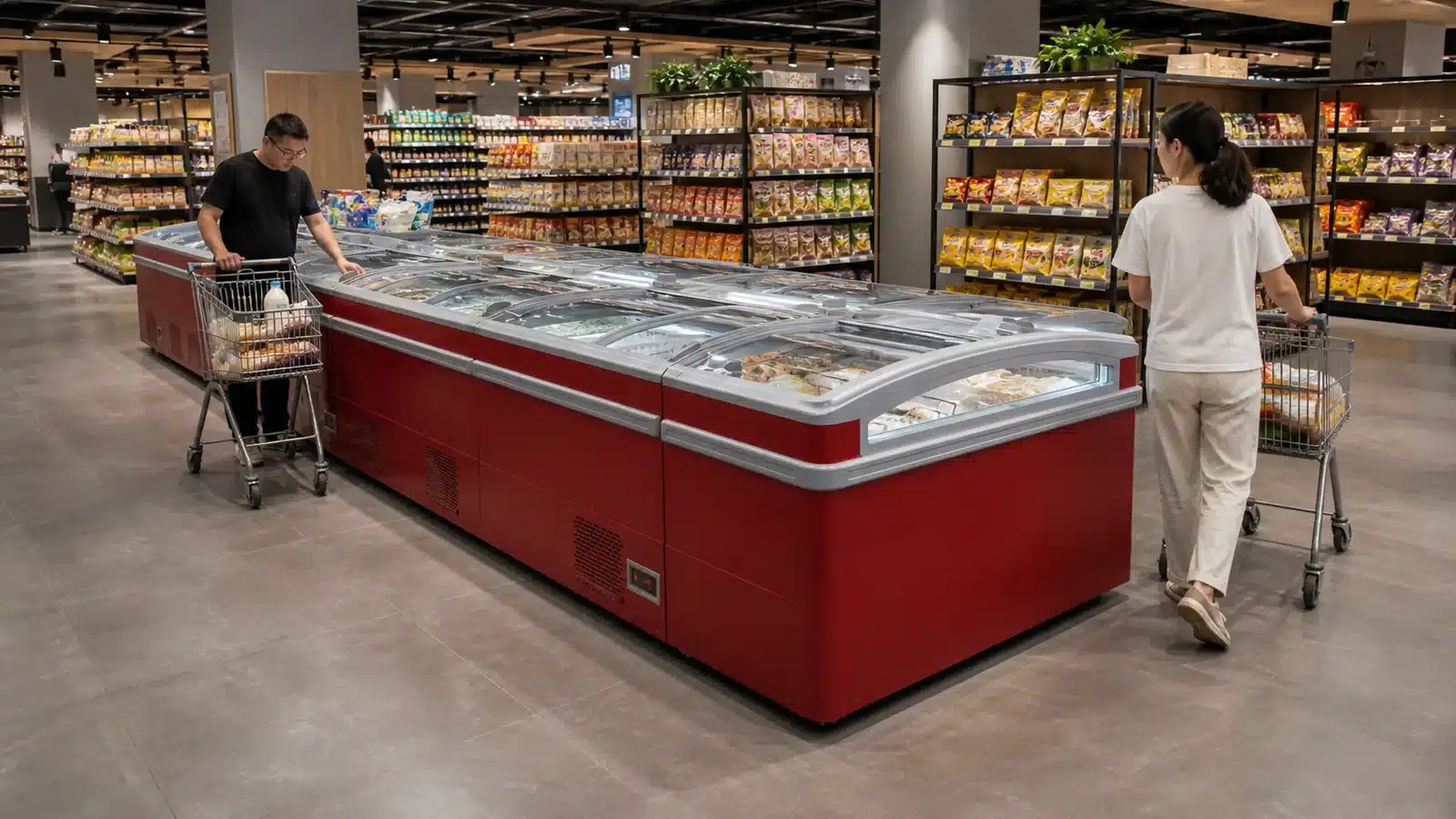
Confirm the Exact Island Arrangement
the layout identifies standard or other approved island structure, end and center modules, sliding-glass direction, exposed ends, and neighboring fixtures. For this combined island freezer shopping trolley turning space task, the responsible team should place cabinet IDs and selected-model outlines on the current store plan and mark which long sides and ends customers can approach. The check belongs at the point where the physical condition and its identity can still be verified together.
At the confirm the exact island arrangement stage, retain product title, model, module sequence, lid structure, plan revision, application, and responsible planner. Link each photograph, count, mark, drawing, or note to the combined island freezer shopping trolley turning space item it describes, including the current location and responsible role where those facts matter.
A generic island symbol cannot represent every glass profile and module arrangement. That boundary governs combined island freezer shopping trolley turning space, not a different product or site. When evidence supports more than one interpretation, record the uncertainty and route it to the qualified decision owner.
Close confirm the exact island arrangement only when the project team releases one exact cabinet footprint and access orientation. If open, preserve the combined island freezer shopping trolley turning space state and name the unresolved point, owner, next evidence, and hold or follow-up action before physical custody or project work changes.
Before moving on, compare product title, model, module sequence, lid structure, plan revision, application, and responsible planner with the release condition: the project team releases one exact cabinet footprint and access orientation. This final comparison gives the combined island freezer shopping trolley turning space handoff enough context for the next buyer, supplier, warehouse, installer, operator, or project reviewer to act without rebuilding the chronology.
Map Real Trolley Approach Paths
the plan shows where shoppers enter the aisle, approach the display, turn at ends, cross openings, and leave for checkout or other departments. For this combined island freezer shopping trolley turning space task, the responsible team should observe the intended path or run a scale-plan exercise with the store's actual trolley envelope and fixed fixtures. The check belongs at the point where the physical condition and its identity can still be verified together.
At the map real trolley approach paths stage, retain approach arrows, turn points, columns, baskets, signs, aisle crossings, sightline constraints, and peak-use assumptions. Link each photograph, count, mark, drawing, or note to the combined island freezer shopping trolley turning space item it describes, including the current location and responsible role where those facts matter.
This article cannot invent local code or accessibility dimensions. That boundary governs combined island freezer shopping trolley turning space, not a different product or site. When evidence supports more than one interpretation, record the uncertainty and route it to the qualified decision owner.
Close map real trolley approach paths only when the store and project owner accept the paths that require physical testing. If open, preserve the combined island freezer shopping trolley turning space state and name the unresolved point, owner, next evidence, and hold or follow-up action before physical custody or project work changes.
Before moving on, compare approach arrows, turn points, columns, baskets, signs, aisle crossings, sightline constraints, and peak-use assumptions with the release condition: the store and project owner accept the paths that require physical testing. This final comparison gives the combined island freezer shopping trolley turning space handoff enough context for the next buyer, supplier, warehouse, installer, operator, or project reviewer to act without rebuilding the chronology.
Model Stopping at the Sliding Glass Lids
a shopper and trolley can stop while the relevant lid opens and another customer understands the remaining route. For this combined island freezer shopping trolley turning space task, the responsible team should mark trolley position, user reach, lid movement, browsing space, product selection, and likely dwell zones on both long sides. The check belongs at the point where the physical condition and its identity can still be verified together.
At the model stopping at the sliding glass lids stage, retain closed and open lid views, trolley orientation, user zone, passing conflict, and proposed adjustment. Link each photograph, count, mark, drawing, or note to the combined island freezer shopping trolley turning space item it describes, including the current location and responsible role where those facts matter.
Cabinet alignment approval does not prove customer-use clearance. That boundary governs combined island freezer shopping trolley turning space, not a different product or site. When evidence supports more than one interpretation, record the uncertainty and route it to the qualified decision owner.
Close model stopping at the sliding glass lids only when normal lid access works in the released merchandising arrangement. If open, preserve the combined island freezer shopping trolley turning space state and name the unresolved point, owner, next evidence, and hold or follow-up action before physical custody or project work changes.
Before moving on, compare closed and open lid views, trolley orientation, user zone, passing conflict, and proposed adjustment with the release condition: normal lid access works in the released merchandising arrangement. This final comparison gives the combined island freezer shopping trolley turning space handoff enough context for the next buyer, supplier, warehouse, installer, operator, or project reviewer to act without rebuilding the chronology.
Customer Circulation Scenario Matrix
Use scenarios to reveal conflicts that a cabinet footprint alone cannot show.
| Review Point | Evidence | Hold or Release Question |
|---|---|---|
| Approach | Actual trolley envelope and entry direction | Can shoppers reach intended sides? |
| Stop and open | Trolley, user and sliding-lid positions | Is product access workable? |
| Pass and turn | Second trolley, end turn and cross aisle | Where must customers wait or reroute? |
| Store change | Temporary fixtures and campaign resets | Who protects the approved route? |
Test Turns at End Modules
end approaches account for curved or straight project geometry, guards, signs, columns, cross aisles, and the first lid-access position. For this combined island freezer shopping trolley turning space task, the responsible team should perform end-turn tests in both directions and record wheel path or swept envelope using approved planning methods. The check belongs at the point where the physical condition and its identity can still be verified together.
At the test turns at end modules stage, retain end-module identity, adjacent fixture, turn direction, contact risk, pause point, and alternate route. Link each photograph, count, mark, drawing, or note to the combined island freezer shopping trolley turning space item it describes, including the current location and responsible role where those facts matter.
Renaming or rotating a plan symbol cannot fix an end condition that fails the physical scenario. That boundary governs combined island freezer shopping trolley turning space, not a different product or site. When evidence supports more than one interpretation, record the uncertainty and route it to the qualified decision owner.
Close test turns at end modules only when each exposed end supports the intended customer movement. If open, preserve the combined island freezer shopping trolley turning space state and name the unresolved point, owner, next evidence, and hold or follow-up action before physical custody or project work changes.
Before moving on, compare end-module identity, adjacent fixture, turn direction, contact risk, pause point, and alternate route with the release condition: each exposed end supports the intended customer movement. This final comparison gives the combined island freezer shopping trolley turning space handoff enough context for the next buyer, supplier, warehouse, installer, operator, or project reviewer to act without rebuilding the chronology.
Add Two-Trolley and Assisted-Shopping Scenarios
the route is reviewed when one customer stops and another passes, or when a companion stands beside the freezer. For this combined island freezer shopping trolley turning space task, the responsible team should test representative combinations chosen by the store without treating a single quiet walkthrough as the maximum demand. The check belongs at the point where the physical condition and its identity can still be verified together.
At the add two-trolley and assisted-shopping scenarios stage, retain scenario list, conflict location, waiting behavior, route ownership, fixture change, and accepted limitation. Link each photograph, count, mark, drawing, or note to the combined island freezer shopping trolley turning space item it describes, including the current location and responsible role where those facts matter.
The workflow is a project usability review rather than a performance guarantee for every crowd condition. That boundary governs combined island freezer shopping trolley turning space, not a different product or site. When evidence supports more than one interpretation, record the uncertainty and route it to the qualified decision owner.
Close add two-trolley and assisted-shopping scenarios only when the operating team accepts a clear passing and waiting strategy. If open, preserve the combined island freezer shopping trolley turning space state and name the unresolved point, owner, next evidence, and hold or follow-up action before physical custody or project work changes.
Before moving on, compare scenario list, conflict location, waiting behavior, route ownership, fixture change, and accepted limitation with the release condition: the operating team accepts a clear passing and waiting strategy. This final comparison gives the combined island freezer shopping trolley turning space handoff enough context for the next buyer, supplier, warehouse, installer, operator, or project reviewer to act without rebuilding the chronology.
Protect the Route From Temporary Fixtures
promotional displays, shopping baskets, price stands, stock carts, waste bins, and seasonal fixtures never occupy the approved trolley zones unexpectedly. For this combined island freezer shopping trolley turning space task, the responsible team should add no-storage or controlled-display zones to the merchandising plan and repeat the test after campaign changes. The check belongs at the point where the physical condition and its identity can still be verified together.
At the protect the route from temporary fixtures stage, retain approved fixture footprint, owner, campaign dates, before and after route photos, exception contact, and reset condition. Link each photograph, count, mark, drawing, or note to the combined island freezer shopping trolley turning space item it describes, including the current location and responsible role where those facts matter.
A good commissioning test loses value when later teams are unaware of its boundaries. That boundary governs combined island freezer shopping trolley turning space, not a different product or site. When evidence supports more than one interpretation, record the uncertainty and route it to the qualified decision owner.
Close protect the route from temporary fixtures only when store-change procedures preserve or revalidate the customer route. If open, preserve the combined island freezer shopping trolley turning space state and name the unresolved point, owner, next evidence, and hold or follow-up action before physical custody or project work changes.
Before moving on, compare approved fixture footprint, owner, campaign dates, before and after route photos, exception contact, and reset condition with the release condition: store-change procedures preserve or revalidate the customer route. This final comparison gives the combined island freezer shopping trolley turning space handoff enough context for the next buyer, supplier, warehouse, installer, operator, or project reviewer to act without rebuilding the chronology.
Buyer Checklist
- Use the exact combined-island structure and module plan.
- Map trolley entries, exits, ends, and crossings.
- Test stopping with sliding lids in use.
- Run turns in both directions at exposed ends.
- Include passing and companion scenarios.
- Record assumptions and physical test results.
- Recheck after temporary fixture changes.
Frequently Asked Questions
What trolley turning dimension should every store use?
There is no universal value in this article. Use the actual trolley, selected cabinet, local requirements, customer profile, fixed fixtures, and qualified store design.
Is a stock-cart route the same as a customer trolley route?
No. Replenishment has different timing, ownership, load, stopping, and lid-access behavior; the two routes should be coordinated but recorded separately.
Can an island freezer image show a chest freezer?
No. The visual must preserve the approved combined-island structure with low horizontal modules and sliding glass lids.
Related Product or Reading
Use the commercial island freezer category to confirm the exact structure before performing the circulation scenarios.
Discuss the Exact Project
Send XCCOLD the selected island-freezer model, module sequence, current floor plan, trolley dimensions, cross aisles, fixed and temporary fixtures, customer approach sides, and scenario results.