
Choosing an island freezer is not only about cabinet size or purchase price. One of the most important decisions is whether the supermarket needs a plug-in system with an integrated compressor or a remote system connected to an external condensing unit.
Both systems can maintain frozen products at the required low temperature, but they differ significantly in installation, store heat, noise, layout flexibility, maintenance and project planning.
A plug-in island freezer is usually easier to install and relocate. A remote island freezer is more suitable for larger, permanent frozen food sections where several cabinets form a continuous display line.
The better choice depends on the store, not on which system sounds more advanced.
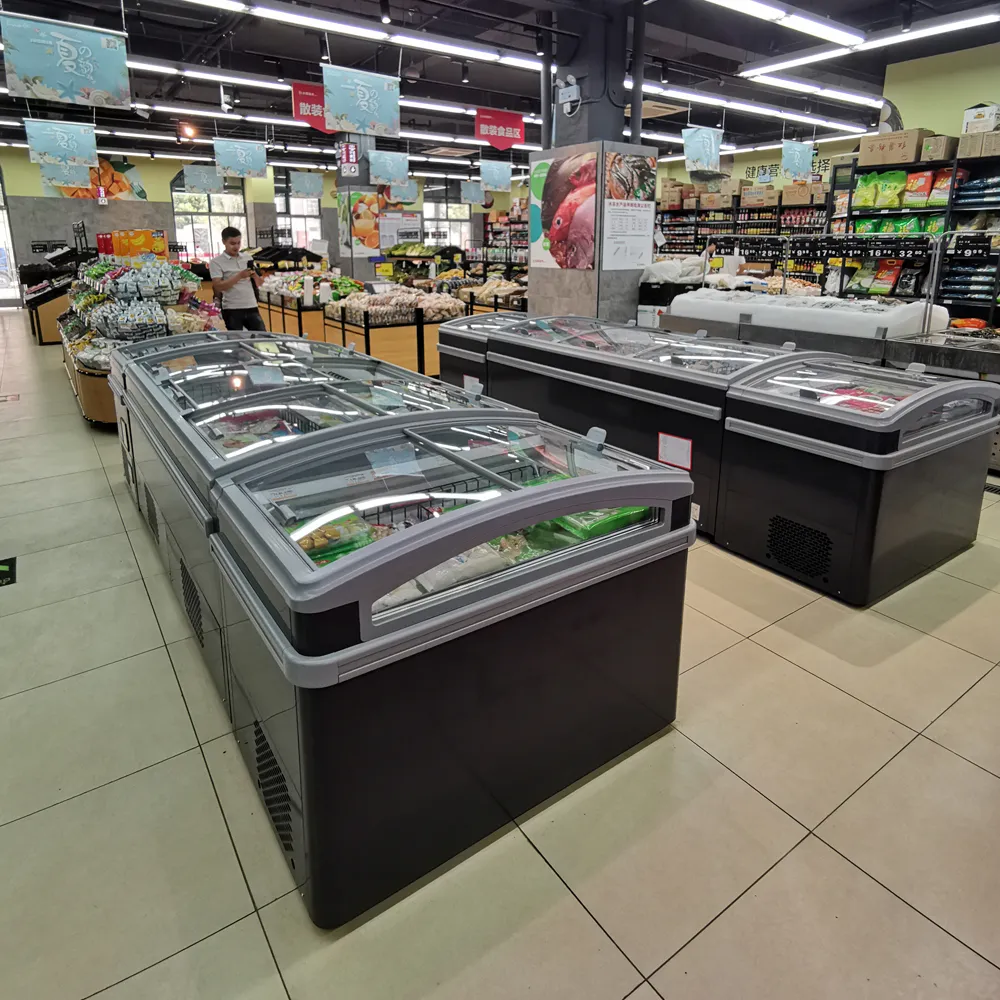
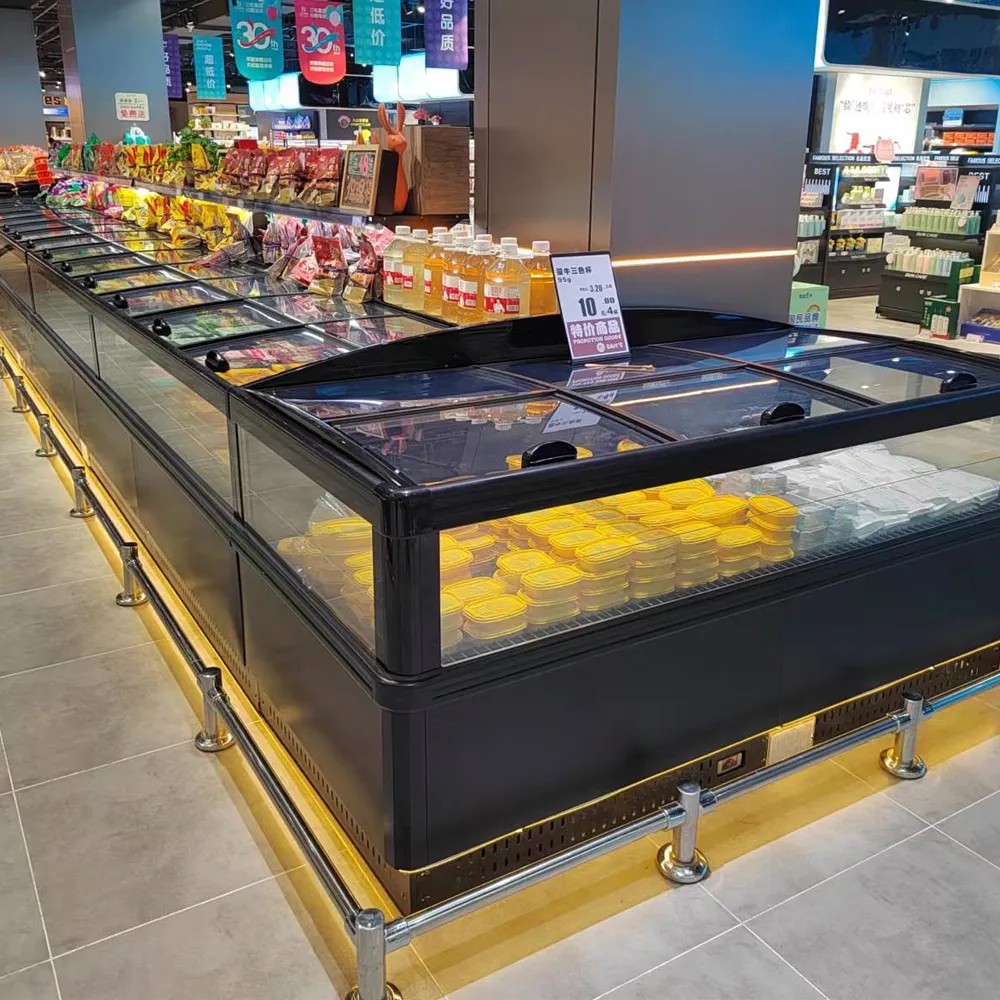
Plug-in and remote island freezer comparison for supermarkets
Quick Answer
Choose a plug-in island freezer when:
- The store needs simple installation
- Only one or several independent cabinets are required
- The layout may change in the future
- No external refrigeration piping is available
- The project needs a lower initial installation cost
- A self-contained refrigeration system is preferred
Choose a remote island freezer when:
- The supermarket is planning a large frozen food section
- Several cabinets will form a long display line
- An external machine room or condensing-unit location is available
- The retailer wants to reduce compressor heat and noise inside the sales area
- The project already uses a centralized refrigeration system
- Larger display volume and permanent installation are priorities
These are starting points rather than universal rules. Refrigeration capacity, ambient conditions, electrical supply, service access and local regulations must also be considered.
What Is a Plug-In Island Freezer?
A plug-in island freezer is a self-contained refrigerated display cabinet. The compressor, condenser, evaporator and controls are integrated into the equipment.
After the freezer is delivered and positioned, it normally requires a suitable electrical supply, proper ventilation around the condensing section and commissioning according to the manufacturer’s instructions.
It does not require a separate condensing unit or long refrigerant piping between the cabinet and an external machine room.
This makes plug-in models attractive for:
- Convenience stores
- Small and medium-sized supermarkets
- Frozen food shops
- Promotional frozen food areas
- Supermarket renovation projects
- Stores that may change their layout
- Retailers that need independent refrigeration units
However, “plug-in” should not be interpreted as “place it anywhere and switch it on.” The power supply, circuit protection, ventilation space, floor level and local electrical requirements still need to be confirmed.
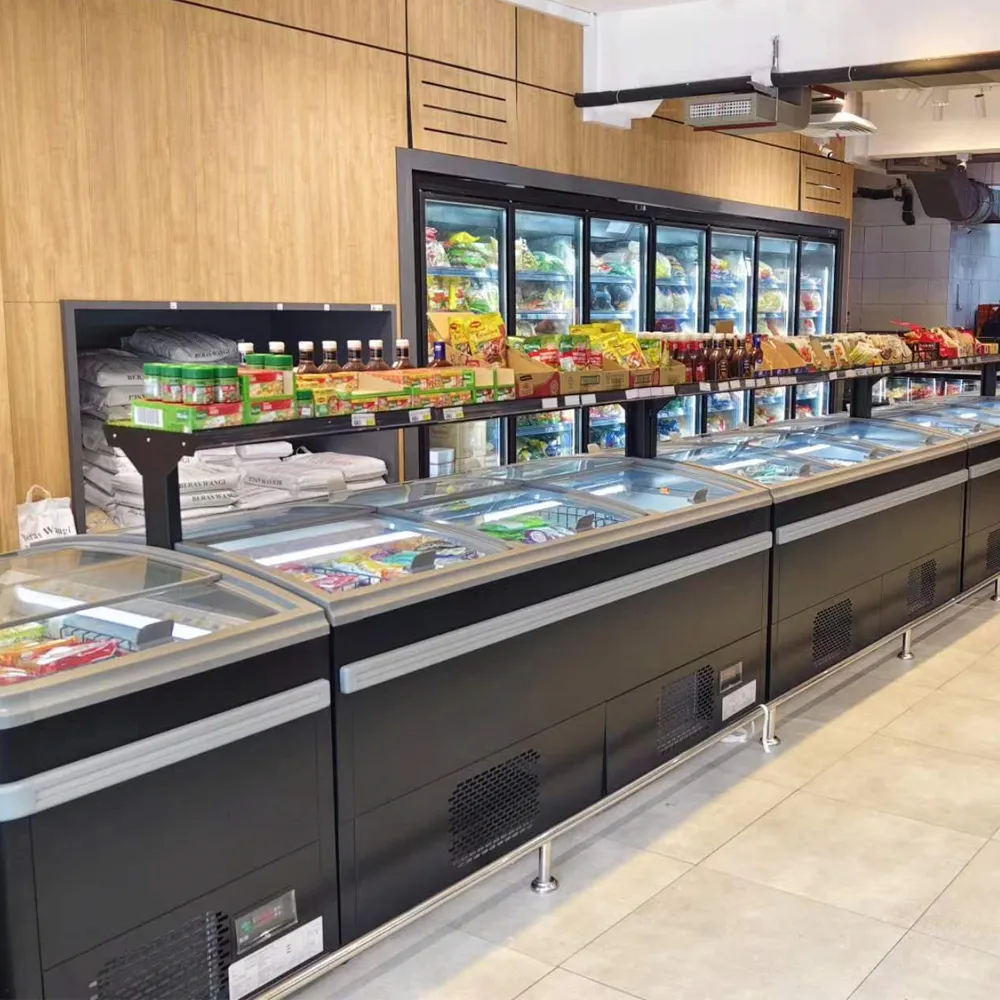
Advantages of a Plug-In Island Freezer
Simpler Installation
The refrigeration circuit is built into the cabinet, so the store does not need to install separate refrigerant piping to a remote condensing unit.
This can reduce installation time and make the equipment easier to add to an existing store.
Greater Layout Flexibility
Self-contained cabinets can normally be repositioned more easily than remote cabinets, provided that electrical and ventilation requirements are still met.
This is useful for retailers that frequently change promotional zones or frozen food layouts.
Independent Operation
Each plug-in cabinet has its own refrigeration system. If one unit requires service, the problem is normally limited to that cabinet rather than automatically affecting the entire freezer line.
The store should still have a product-transfer plan in case any freezer stops operating.
Lower Initial Project Complexity
A plug-in system usually requires fewer site-specific refrigeration engineering decisions. It can be practical when the project does not have a machine room or an existing centralized refrigeration system.
Limitations of a Plug-In Island Freezer
Heat Is Released into the Store
The condenser rejects heat near the cabinet. When several plug-in freezers operate in the same area, they can add to the store’s internal cooling load.
The actual effect depends on equipment efficiency, ventilation, ambient temperature and the number of cabinets.
Compressor Noise Remains in the Sales Area
Modern self-contained freezers can operate relatively quietly, but the compressor and condenser fans are still located in or near the cabinet.
Condenser Maintenance Is Distributed
Each cabinet has its own condenser and refrigeration components. Store operators need to keep the condenser areas clean and accessible.
Cabinet Volume May Be Reduced
The integrated refrigeration package occupies part of the equipment footprint. The effect on usable capacity depends on the cabinet design.
What Is a Remote Island Freezer?
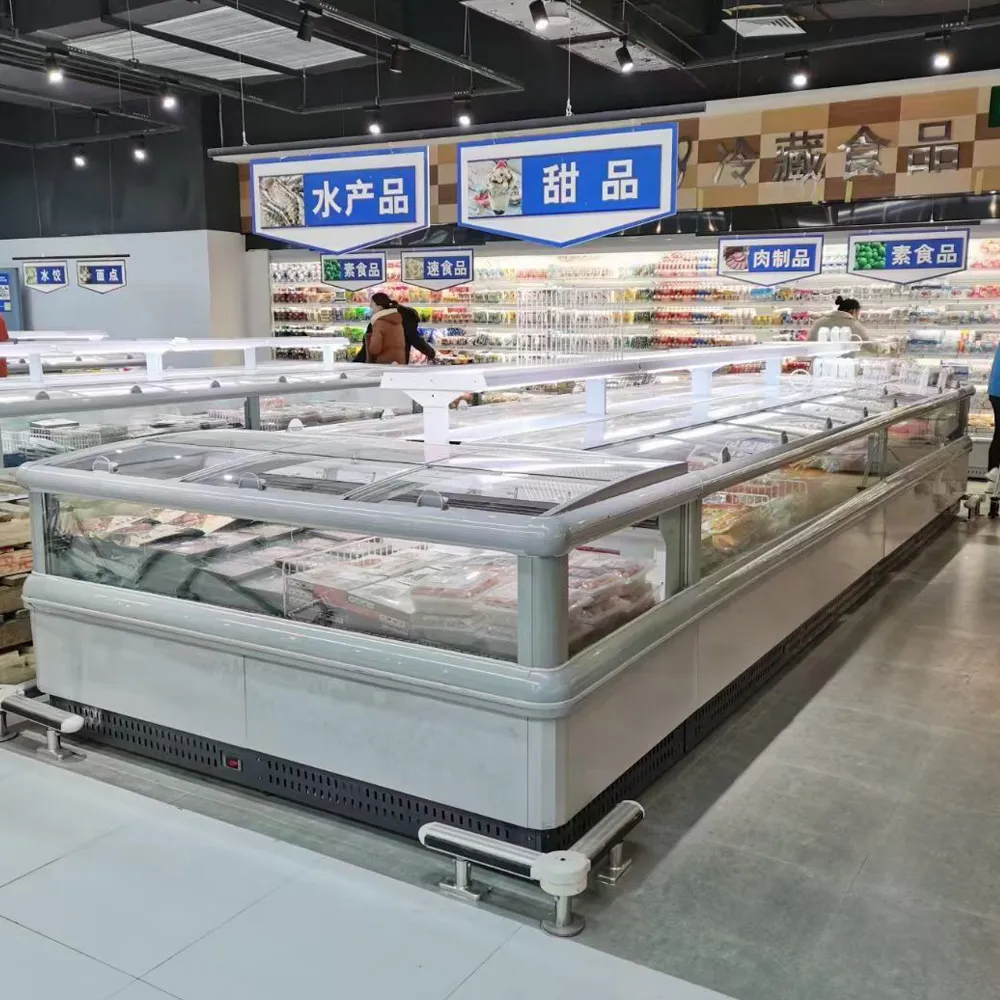
A remote island freezer contains the display cabinet and evaporator section, while the compressor and condenser are installed outside the sales area or in a dedicated machine room.
The cabinet is connected to the remote refrigeration system through refrigerant piping, control wiring and any required drainage or defrost connections.
Remote systems are commonly used in:
- Large supermarkets
- Hypermarkets
- Frozen food departments
- Long modular freezer lines
- New supermarket construction projects
- Stores with centralized refrigeration
- Projects requiring higher display capacity
Remote refrigeration requires professional system design. The condensing unit, refrigeration capacity, pipe sizing, refrigerant, controls, defrost method and installation distance must match the connected cabinets and operating conditions.
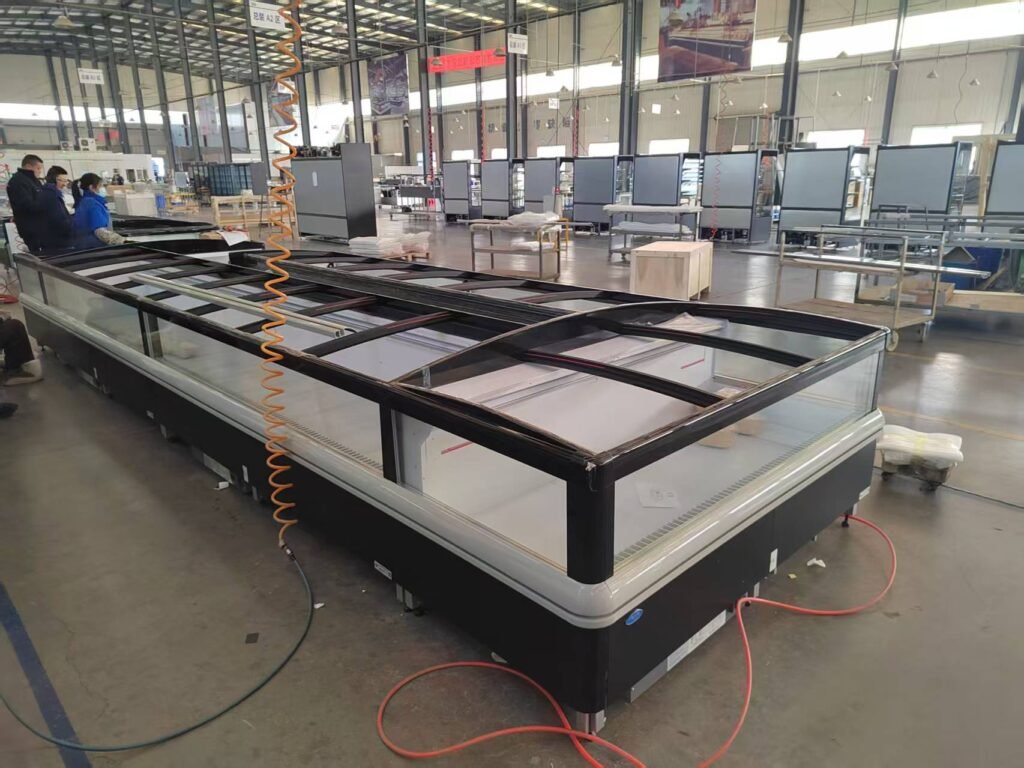
Remote double-sided island freezer installed in a supermarket frozen food section
Advantages of a Remote Island Freezer
Less Compressor Heat inside the Sales Area
The main heat-rejection equipment is installed away from the cabinet. This can reduce the amount of compressor and condenser heat released directly into the shopping area.
This does not mean the cabinet produces no heat at all. Fans, lighting and other electrical components still contribute some heat.
Reduced Mechanical Noise near Customers
Moving the compressor and condensing unit away from the retail floor can reduce mechanical noise around the freezer display.
A remote cabinet is not completely silent because evaporator fans and airflow may still be audible.
Suitable for Long Display Lines
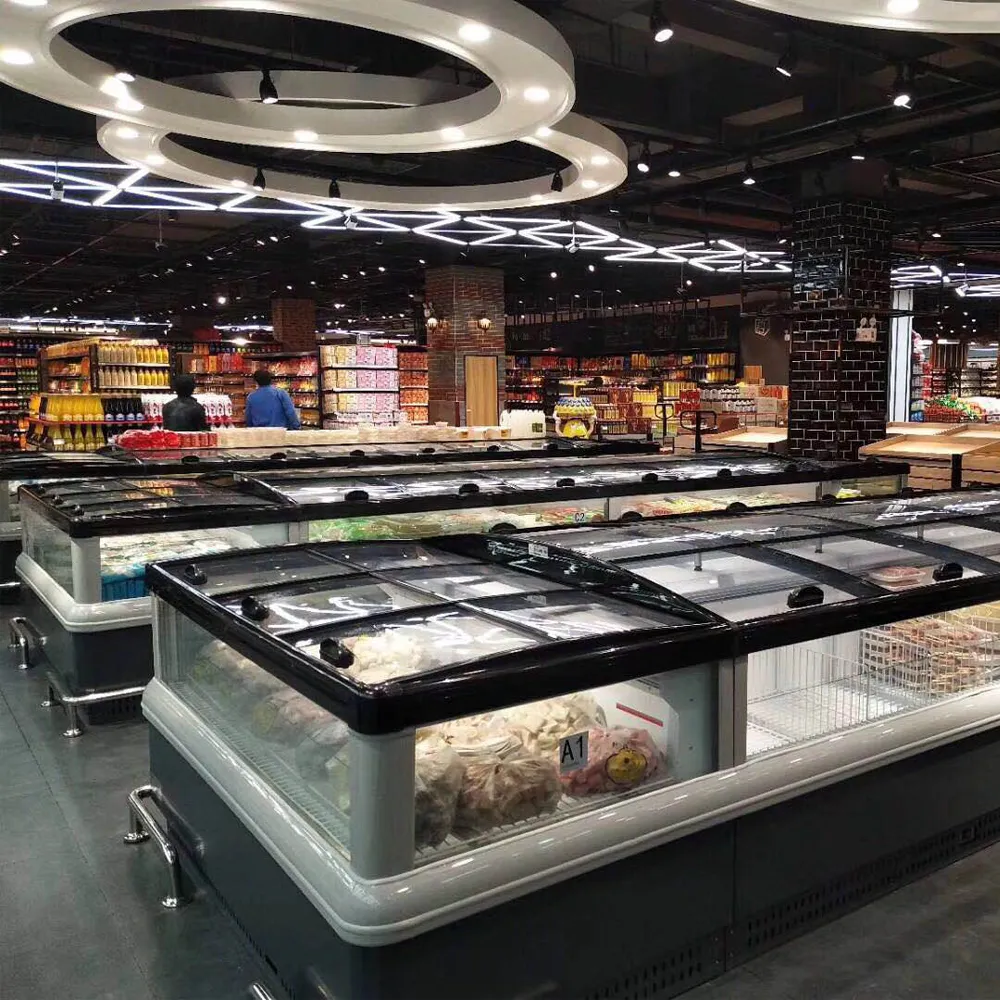
Remote island freezers are well suited to permanent supermarket layouts where several cabinets are joined into a continuous frozen food zone.
Straight cabinets and end cabinets can be arranged to create a complete retail island with customer access from different sides.
Potential for Larger Display Volume
Removing the internal compressor package can allow more of the cabinet footprint to be used for refrigerated display volume, depending on the equipment design.
Centralized Service Planning
Major refrigeration components can be located in a machine room or dedicated service area. This can simplify some maintenance work and reduce the need to access compressors from the sales floor.
Limitations of a Remote Island Freezer
More Complex Installation
A remote system requires refrigeration engineering, piping, pressure testing, evacuation, refrigerant charging, control setup and commissioning.
Incorrect system design or installation can affect temperature stability, efficiency and equipment life.
Higher Initial Project Cost
The total investment may include:
- Remote condensing unit
- Refrigerant piping
- Electrical controls
- Labour
- Insulation
- Drainage
- Commissioning
- Machine room or outdoor installation work
The cabinet price alone does not represent the complete project cost.
Less Flexibility after Installation
Once refrigerant pipes and controls are connected, moving a remote cabinet is more complicated than moving a self-contained unit.
System-Level Failure Risk
If several cabinets depend on one centralized refrigeration system, a major system failure may affect more than one display case.
Large projects should consider alarms, maintenance access, emergency procedures and appropriate redundancy.
Plug-In vs Remote Island Freezer Comparison
| Comparison Point | Plug-In Island Freezer | Remote Island Freezer |
|---|---|---|
| Compressor location | Inside or below the cabinet | Outside the sales area or in a machine room |
| Refrigeration piping | Factory-integrated | Requires site installation |
| Initial installation | Relatively simple | More complex |
| Layout flexibility | Easier to reposition | Usually permanent |
| Heat in sales area | Condenser heat remains indoors | Main heat rejection is moved away |
| Noise near cabinet | Compressor and fan noise remain nearby | Compressor noise is moved away |
| Display-line length | Suitable for independent or modular units | Suitable for long continuous installations |
| Maintenance structure | Each cabinet has its own system | Central or remote system service |
| Failure impact | Normally limited to one cabinet | May affect multiple cabinets, depending on system design |
| Best starting point | Small and medium stores | Large supermarkets and permanent projects |
【IMAGE 4 — Insert a close-up image showing the compressor section of a plug-in island freezer, followed by a remote cabinet image without a built-in compressor. Suggested Alt: Integrated compressor and remote refrigeration system difference】
A Real Example from the XC Cold Island Freezer Range
The difference is easier to understand when comparing actual product configurations.
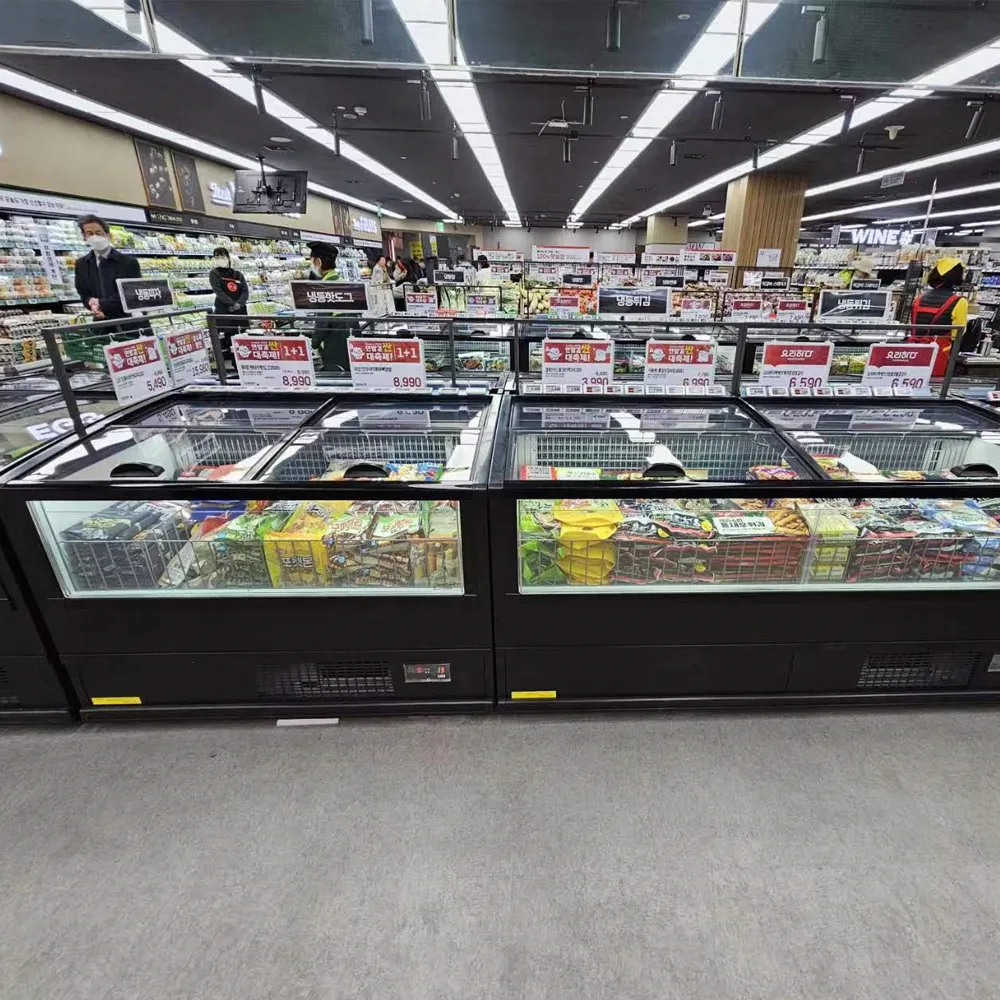
The Plug-in Standard Combined Island Freezer includes self-contained models with listed lengths from approximately 1358mm to 2508mm and effective volumes from approximately 360L to 745L.
These models are designed for frozen food display at or below −18°C and use an integrated refrigeration system. They can be used independently or combined into a larger retail arrangement.
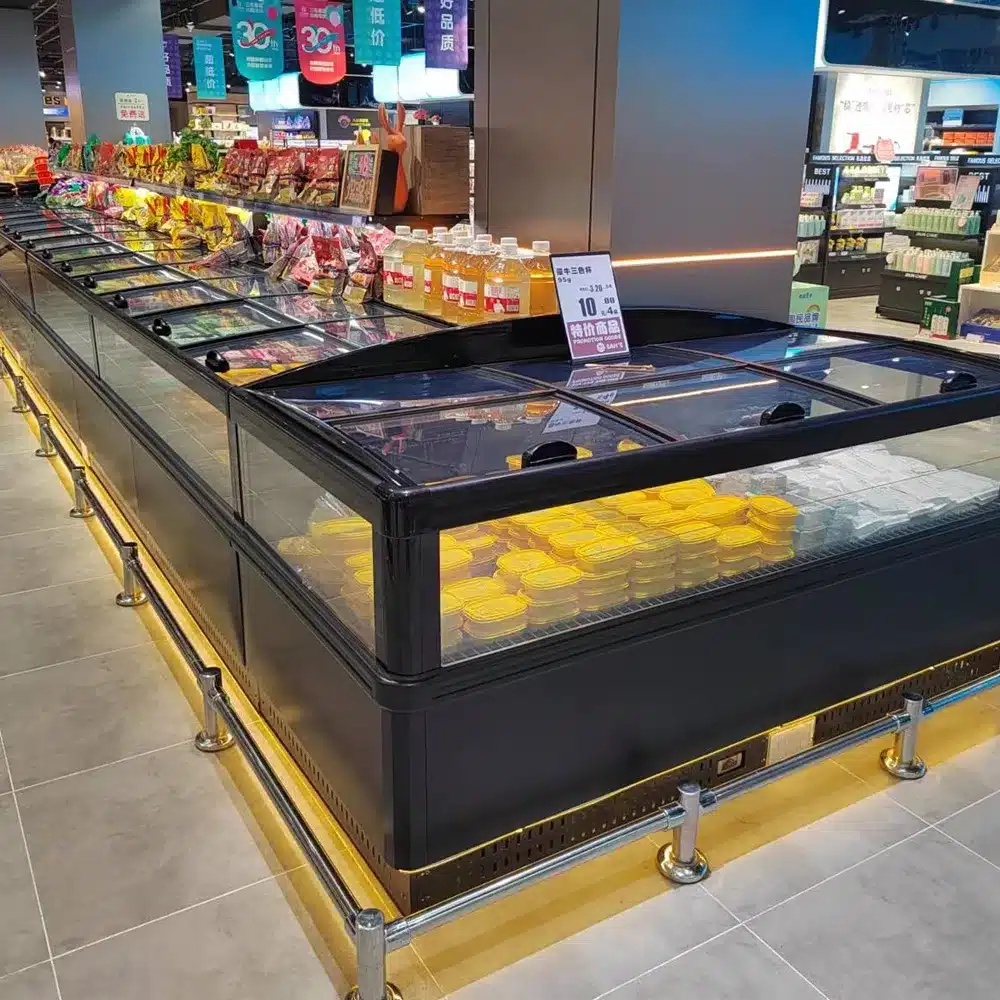
The Remote Double-sided Air Outlet Island Freezer includes larger models with listed effective volumes from approximately 700L to 1680L. Available cabinet widths include 1550mm and 1810mm for different supermarket capacities and floor layouts.
These figures should not be treated as a direct efficiency comparison because the cabinet dimensions are different. They demonstrate how each system can serve a different project scale.
How Store Size Affects the Decision
Convenience Store
A plug-in island freezer is usually the easier starting point.
Convenience stores often need one compact frozen display for ice cream, frozen meals, dumplings or promotional products. A self-contained cabinet can be installed without building a complete remote refrigeration system.
Before ordering, confirm:
- Available floor space
- Delivery path
- Electrical supply
- Ventilation
- Customer access
- Product quantity
Small Supermarket
A small supermarket may use several plug-in combined island freezers.
This allows the retailer to create a frozen food area while retaining the option to adjust the layout later. The store must still consider the total heat released by several self-contained units.
Standard Supermarket
The correct choice depends on whether the supermarket is new or already operating.
A renovation project may favour plug-in cabinets because they reduce construction work. A new supermarket with several refrigerated display sections may benefit from a professionally designed remote system.
Hypermarket
Remote island freezers are often more appropriate for large, permanent frozen food sections.
Long cabinet runs, higher product capacity, external heat rejection and centralized refrigeration can be advantageous. However, the project requires complete engineering rather than a cabinet-only quotation.
Store Layout and Cabinet Dimensions
An island freezer must fit both the frozen food plan and the customer route.
Before selecting a model, confirm:
- Total available length
- Available width
- Shopping-cart clearance
- Customer access from one or both sides
- Restocking route
- Distance to walls and other refrigeration equipment
- Emergency exit and local accessibility requirements
- Service access
- Location of floor drains, columns and power supplies
- Condensing unit location for remote systems
Do not rely only on the freezer’s volume in litres. A high-capacity cabinet may be unsuitable if customers cannot move around it comfortably or staff cannot replenish products efficiently.
Remember the End Panels
Remote island freezer layouts may require end panels that add to the overall installation length.
For example, the remote XC Cold product page lists a 60mm end-panel thickness per side. A single 1875mm cabinet with two 60mm external end panels would have a nominal total length of:
1875mm + 60mm + 60mm = 1995mm
For a multi-cabinet line, add the body lengths and the required external end panels according to the confirmed layout. Do not automatically add two end panels to every connected cabinet.
The final layout should be confirmed with a technical drawing before production.
Heat, Noise and Air-Conditioning Load
One common claim is that remote refrigeration is always more energy-efficient. This is too simple.
A remote system can reduce the condenser heat released into the sales area, which may reduce the load on the store’s air-conditioning system. However, total energy performance also depends on:
- Compressor efficiency
- Condensing temperature
- Pipe length and insulation
- Refrigerant charge
- System controls
- Defrost strategy
- Ambient temperature
- Cabinet loading
- Maintenance quality
- Number of connected cabinets
A poorly selected or poorly installed remote system may not deliver the expected efficiency.
Plug-in systems also vary. Modern self-contained models can use efficient compressors, improved insulation, sliding glass lids, LED lighting and electronic controls.
The correct comparison should use complete project energy data rather than general assumptions about system type.
Frozen Product Temperature Requirements
Island freezers are commonly used for:
- Frozen meat
- Seafood
- Ice cream
- Frozen vegetables
- Frozen dumplings
- Frozen meals
- Frozen desserts
- Packaged frozen food
Many commercial frozen food applications use −18°C or below as a reference condition. The XC Cold island freezer pages list operating temperatures of ≤−18°C or approximately −18°C to −22°C, depending on the model.
The U.S. Food and Drug Administration also identifies 0°F, approximately −18°C, as a standard freezer temperature reference. Buyers should still follow the product manufacturer’s storage instructions and local food regulations. See the FDA guidance on refrigerator and freezer temperatures.
Different products may require different operating conditions. Ice cream texture, for example, can be more sensitive to temperature variation than many packaged frozen foods.
The supplier should know the actual products being displayed before recommending equipment.
Loading and Daily Operation
Even a correctly selected island freezer can perform poorly if it is loaded incorrectly.
Store operators should:
- Respect the maximum loading line
- Avoid blocking air outlets
- Keep sliding glass lids closed when customers are not accessing products
- Separate product categories with baskets or dividers
- Avoid loading warm products directly into the display freezer
- Check the displayed temperature regularly
- Use an independent thermometer where required
- Clean condenser surfaces on plug-in models
- Follow the recommended defrost schedule
- Inspect glass seals and sliding tracks
Display freezers are primarily designed to maintain already-frozen products. They should not automatically be treated as blast freezers for rapidly freezing large quantities of warm food.
Refrigerant and Electrical Requirements
Before ordering, confirm:
- Country of installation
- Voltage
- Frequency
- Phase
- Plug type
- Refrigerant requirement
- Local refrigerant regulations
- Available electrical capacity
- Service technician availability
Some XC Cold plug-in island freezer models are listed with R290 refrigerant. R290 has a low global warming potential, but it is an A3 refrigerant with high flammability. Equipment containing R290 must be installed and serviced according to the manufacturer’s instructions, applicable standards and local regulations.
ASHRAE explains that Class 3 refrigerants include highly flammable hydrocarbons. See the ASHRAE refrigerant safety classification information.
Only appropriately trained personnel should service equipment containing flammable refrigerants.
Maintenance and Service Planning
Plug-In System Maintenance
Plug-in cabinets require access to each integrated refrigeration system.
Maintenance may include:
- Condenser cleaning
- Compressor inspection
- Fan inspection
- Temperature-controller checks
- Glass and seal inspection
- Defrost-system inspection
- Drain cleaning
Because each unit operates independently, maintenance records should identify the exact cabinet and model.
Remote System Maintenance
Remote systems require both cabinet-level and system-level inspection.
Maintenance may include:
- Remote condensing unit
- Refrigerant charge
- Piping insulation
- Solenoid and expansion valves
- Electrical controls
- Evaporator fans
- Defrost system
- Drainage
- Temperature alarms
Service access should be planned before installation, not after equipment is surrounded by shelves, walls or other cabinets.
Which System Should Different Buyers Choose?
| Buyer or Project | Recommended Starting Point | Main Reason |
|---|---|---|
| Convenience store | Plug-in | Simple installation and compact project scope |
| Small supermarket | Plug-in or modular plug-in | Layout flexibility |
| Existing store renovation | Usually plug-in | Less refrigeration construction |
| New standard supermarket | Compare both systems | Depends on total refrigeration plan |
| Hypermarket | Remote | Long lines and higher display capacity |
| Frozen food specialist | Compare by product volume and layout | Both formats may be suitable |
| Temporary promotional zone | Plug-in | Easier relocation |
| Permanent frozen food department | Remote | Centralized project design |
| Distributor stocking standard models | Plug-in | Easier resale and installation |
| Refrigeration contractor | Remote or complete project solution | Engineering capability available |
This table provides a starting point. Final selection should be based on a project drawing and confirmed technical requirements.
Information to Provide Before Requesting a Quotation
To receive an accurate recommendation, prepare:
- Store type and total floor area
- Frozen food section layout
- Available cabinet length and width
- Required customer-access sides
- Frozen product categories
- Required operating temperature
- Expected product volume
- Plug-in or remote preference
- Condensing-unit location
- Refrigerant requirement
- Voltage, frequency and phase
- Quantity
- Indoor ambient temperature and humidity
- Colour and branding requirements
- Required accessories
- Delivery destination
- Installation and commissioning responsibility
For remote projects, include a floor plan and the approximate distance between the cabinets and the proposed condensing-unit location.
Common Purchasing Mistakes
Comparing Only Cabinet Prices
A remote cabinet quotation may not include the condensing unit, piping, installation or commissioning. Compare complete project costs.
Ignoring Heat Rejection
Several plug-in units can add heat to the store. Confirm ventilation and air-conditioning capacity.
Selecting Capacity before Planning the Layout
A large cabinet is not useful if it blocks customer movement or prevents efficient restocking.
Assuming Remote Means Zero Noise
Remote refrigeration reduces compressor noise near the cabinet, but fans and airflow remain.
Assuming Remote Is Always More Efficient
Energy performance depends on the complete system and operating conditions.
Forgetting End Panels
End panels, crown cabinets and joining kits affect the total line length.
Ordering before Confirming the Electrical Supply
Voltage, frequency and phase must match the installation site.
Ignoring Refrigerant Safety and Local Rules
Refrigerant selection affects servicing, installation and regulatory requirements.
Frequently Asked Questions
Is a Plug-In Island Freezer Easier to Install?
Yes. Its refrigeration system is integrated into the cabinet, so it usually requires less site refrigeration work. A suitable electrical supply, ventilation and commissioning are still required.
Does a Remote Island Freezer Produce No Heat inside the Store?
No. Moving the condensing unit removes the main compressor and condenser heat from the cabinet area, but fans, lights and other components still produce some heat.
Which System Is Better for a Small Supermarket?
Plug-in island freezers are often more practical for smaller stores because they are easier to install and reposition. A remote system may still be suitable if the store already has centralized refrigeration.
Which System Provides More Capacity?
Remote cabinets can offer more usable display volume because they do not contain the complete condensing package. Actual capacity must be compared between specific models with similar external dimensions.
Can Several Plug-In Island Freezers Be Combined?
Yes. Some plug-in combined island freezer models can be arranged in modular lines or back-to-back layouts. Each unit still has its own refrigeration system.
Can a Remote Island Freezer Be Moved Later?
It can be moved, but relocation requires changes to refrigerant piping, controls and commissioning. It is less flexible than moving a self-contained cabinet.
Which System Is More Energy-Efficient?
There is no universal answer. Compare the full system, including cabinet power, condensing equipment, air-conditioning load, controls and operating conditions.
What Temperature Should an Island Freezer Maintain?
Many frozen food applications require approximately −18°C or below. The correct setting depends on the food product, equipment specifications and local regulations.
Final Recommendation
Choose a plug-in island freezer when the project requires simple installation, independent operation and future layout flexibility.
Choose a remote island freezer when the store needs a permanent, high-capacity frozen food section connected to a professionally designed refrigeration system.
The final decision should be based on:
- Store layout
- Frozen product categories
- Display capacity
- Installation conditions
- Heat and noise management
- Electrical supply
- Maintenance resources
- Total project cost
XC Cold offers both plug-in and remote commercial island freezer solutions for supermarkets, convenience stores and frozen food retail projects.
Send us your store layout, required temperature, frozen product categories and installation conditions. We can help compare cabinet configurations and prepare a more suitable island freezer solution.
Contact XC Cold for an Island Freezer Recommendation
About the Author
David Song has more than 10 years of experience in international trade and works with commercial refrigeration equipment for supermarkets and food retail projects. His content focuses on equipment selection, technical specifications, store layout requirements and practical sourcing information for overseas buyers.
Last updated: August 3, 2026