
An open-front chiller is unusually exposed during ceiling, floor, painting, cutting, or fixture work nearby. Fine dust and debris can reach shelves and openings, temporary sheeting can obstruct cabinet areas, contractors may use the base as a work surface, and a visually clean case may be returned to service without the right inspection.
Create a project boundary before work starts. Empty and control product under store procedures, identify the exact open chiller, agree isolation responsibility, position temporary dust protection around rather than dangerously within the equipment, inspect the area after construction cleaning, and leave technical restart to qualified roles using the applicable model and project documents.
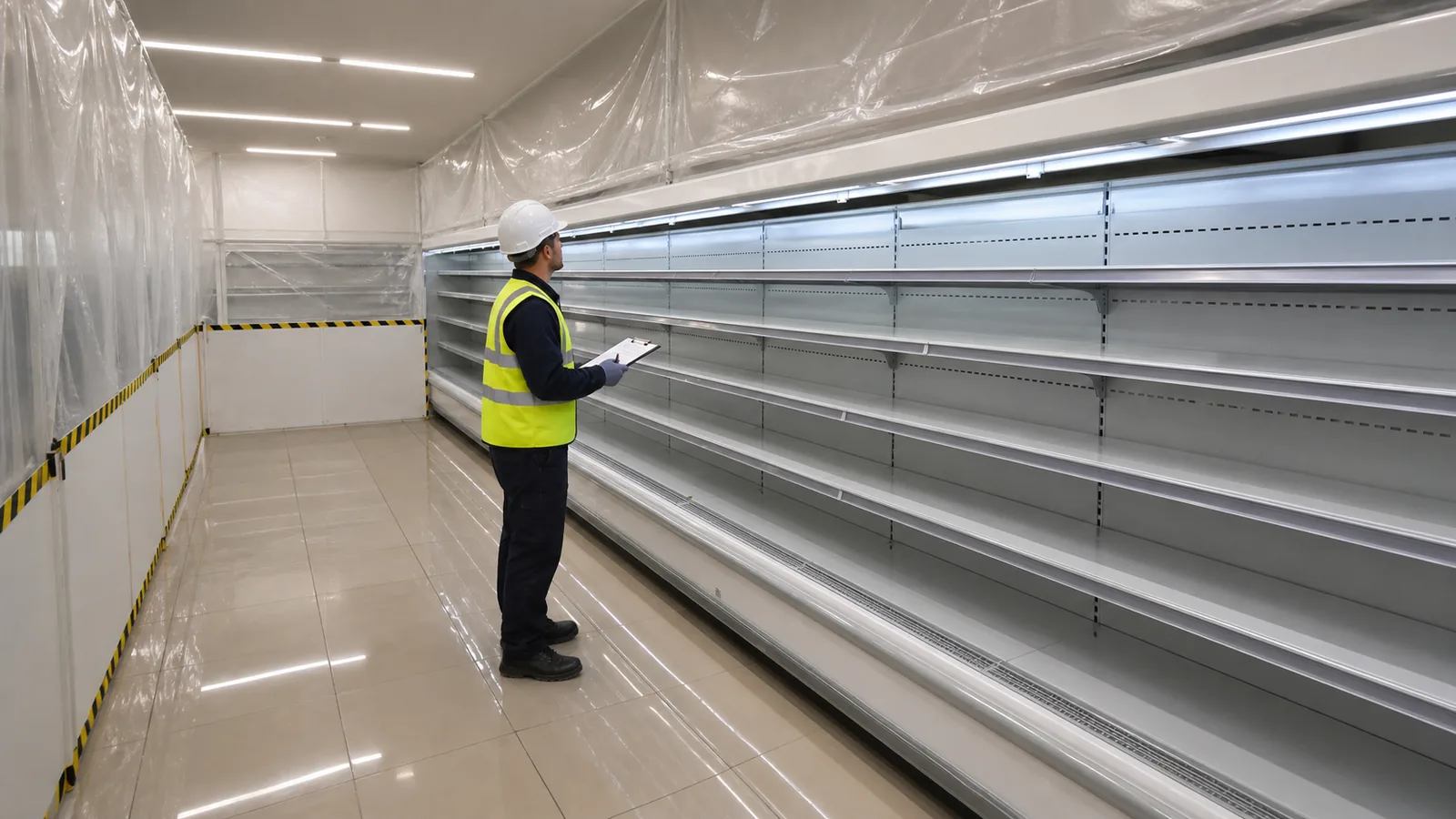
Define the Refurbishment Interface
Map work type, distance, duration, dust source, access, and responsible contractor around the chiller. For the open chiller refurbishment dust protection workflow, this checkpoint joins work package, cabinet asset ID, work boundary, and dust or debris source to a named status and responsible role.
Traceable Records
- work package: Link work package to the physical open chiller refurbishment dust protection item; note evidence, custody, date, exception state, and authorized follow-up.
- cabinet asset ID: Link cabinet asset ID to the physical open chiller refurbishment dust protection item; note evidence, custody, date, exception state, and authorized follow-up.
- work boundary: Link work boundary to the physical open chiller refurbishment dust protection item; note evidence, custody, date, exception state, and authorized follow-up.
- dust or debris source: Link dust or debris source to the physical open chiller refurbishment dust protection item; note evidence, custody, date, exception state, and authorized follow-up.
- schedule: Link schedule to the physical open chiller refurbishment dust protection item; note evidence, custody, date, exception state, and authorized follow-up.
- contractor: Link contractor to the physical open chiller refurbishment dust protection item; note evidence, custody, date, exception state, and authorized follow-up.
Control risk: Treating all refurbishment as low-dust decorating when cutting or ceiling work may occur. Use work package and cabinet asset ID to reconstruct this open chiller refurbishment dust protection event. If work boundary conflicts with dust or debris source, protect the affected item and name the reviewer.
Authorized release: The work and equipment interface has named risks and ownership. Record the open chiller refurbishment dust protection outcome beside schedule, contractor, and store owner; unresolved evidence keeps the stage open.
Clear Product and Assign Cabinet Status
Control displayed stock and mark the cabinet out of normal use through store procedures. For the open chiller refurbishment dust protection workflow, this checkpoint joins product clearance, destination, cabinet status, and power responsibility to a named status and responsible role.
Evidence to Capture
- product clearance: For open chiller refurbishment dust protection, capture product clearance at its source; connect product clearance to an owner, current status, location, and date.
- destination: For open chiller refurbishment dust protection, capture destination at its source; connect destination to an owner, current status, location, and date.
- cabinet status: For open chiller refurbishment dust protection, capture cabinet status at its source; connect cabinet status to an owner, current status, location, and date.
- power responsibility: For open chiller refurbishment dust protection, capture power responsibility at its source; connect power responsibility to an owner, current status, location, and date.
- shelf condition: For open chiller refurbishment dust protection, capture shelf condition at its source; connect shelf condition to an owner, current status, location, and date.
- access restriction: For open chiller refurbishment dust protection, capture access restriction at its source; connect access restriction to an owner, current status, location, and date.
Exception analysis: Covering a stocked open case and leaving product and equipment states ambiguous. In the open chiller refurbishment dust protection file, compare product clearance with destination; use cabinet status and power responsibility to locate the break. Keep shelf condition visible while the assigned role investigates.
Release evidence: Product custody and cabinet operating status are explicit. For open chiller refurbishment dust protection, connect that result to access restriction and release owner, including any open owner and next review date.
Design the Dust Boundary
Place sheeting, rigid barriers, floor protection, and access so they remain separate from the cabinet rather than becoming unapproved covers. For the open chiller refurbishment dust protection workflow, this checkpoint joins barrier location, sheeting support, floor seal, and worker access to a named status and responsible role.
Owner's Working Record
- barrier location: Locate the evidence for barrier location, then place it in the open chiller refurbishment dust protection record with responsibility and timing visible.
- sheeting support: Locate the evidence for sheeting support, then place it in the open chiller refurbishment dust protection record with responsibility and timing visible.
- floor seal: Locate the evidence for floor seal, then place it in the open chiller refurbishment dust protection record with responsibility and timing visible.
- worker access: Locate the evidence for worker access, then place it in the open chiller refurbishment dust protection record with responsibility and timing visible.
- cabinet clearance: Locate the evidence for cabinet clearance, then place it in the open chiller refurbishment dust protection record with responsibility and timing visible.
- ventilation and service boundary: Locate the evidence for ventilation and service boundary, then place it in the open chiller refurbishment dust protection record with responsibility and timing visible.
Failure path: Attaching temporary materials to shelves, vents, controls, or other cabinet parts without approval. Test the open chiller refurbishment dust protection sequence through barrier location, sheeting support, and floor seal. A mismatch should remain attached to worker access, not disappear inside a general comment.
Closeout point: The barrier isolates construction work while respecting equipment boundaries. Close this open chiller refurbishment dust protection stage only when cabinet clearance, ventilation and service boundary, and inspection point support the same status.
Control Contractor Behavior
Include cabinet protection in induction, material staging, tool use, and daily closeout. For the open chiller refurbishment dust protection workflow, this checkpoint joins induction, no-storage zone, tool and material staging, and daily barrier check to a named status and responsible role.
Decision Fields
- induction: Treat induction as a decision field for open chiller refurbishment dust protection; preserve the observed value, its source, reviewer, and unresolved status.
- no-storage zone: Treat no-storage zone as a decision field for open chiller refurbishment dust protection; preserve the observed value, its source, reviewer, and unresolved status.
- tool and material staging: Treat tool and material staging as a decision field for open chiller refurbishment dust protection; preserve the observed value, its source, reviewer, and unresolved status.
- daily barrier check: Treat daily barrier check as a decision field for open chiller refurbishment dust protection; preserve the observed value, its source, reviewer, and unresolved status.
- debris removal: Treat debris removal as a decision field for open chiller refurbishment dust protection; preserve the observed value, its source, reviewer, and unresolved status.
- incident route: Treat incident route as a decision field for open chiller refurbishment dust protection; preserve the observed value, its source, reviewer, and unresolved status.
Reason for control: Allowing the empty chiller or base to become a convenient shelf or workbench. The open chiller refurbishment dust protection reviewer uses induction to identify the item, no-storage zone to confirm context, and tool and material staging to show responsibility. Any conflict stays linked to daily barrier check.
Decision gate: Contractors understand and follow the protected-zone controls. The open chiller refurbishment dust protection decision cites debris removal, records incident route, and leaves supervisor open if follow-up remains.
Inspect After Construction Cleaning
Remove barriers in a controlled sequence and record accessible shelves, openings, panels, floor, and damage. For the open chiller refurbishment dust protection workflow, this checkpoint joins barrier removal, debris observation, shelf and interior, and air opening to a named status and responsible role.
Handover Evidence
- barrier removal: The open chiller refurbishment dust protection handoff names barrier removal, where it was checked, who checked it, and what must happen next.
- debris observation: The open chiller refurbishment dust protection handoff names debris observation, where it was checked, who checked it, and what must happen next.
- shelf and interior: The open chiller refurbishment dust protection handoff names shelf and interior, where it was checked, who checked it, and what must happen next.
- air opening: The open chiller refurbishment dust protection handoff names air opening, where it was checked, who checked it, and what must happen next.
- lighting: The open chiller refurbishment dust protection handoff names lighting, where it was checked, who checked it, and what must happen next.
- panel condition: The open chiller refurbishment dust protection handoff names panel condition, where it was checked, who checked it, and what must happen next.
Review trigger: Switching directly from contractor cleaning to merchandising without a cabinet-specific inspection. When that trigger appears, the open chiller refurbishment dust protection owner checks barrier removal against debris observation, preserves shelf and interior, and routes air opening to the proper authority.
Handover test: The visible condition is documented and exceptions are routed before technical release. The next open chiller refurbishment dust protection role receives lighting, panel condition, and the current state of photographs rather than a verbal assurance.
Require Qualified Restart and Store Handover
Separate visual cleanliness from technical readiness and operating release. For the open chiller refurbishment dust protection workflow, this checkpoint joins model documentation, qualified role, electrical or system checks as applicable, and service exception to a named status and responsible role.
Traceable Records
- model documentation: Link model documentation to the physical open chiller refurbishment dust protection item; note evidence, custody, date, exception state, and authorized follow-up.
- qualified role: Link qualified role to the physical open chiller refurbishment dust protection item; note evidence, custody, date, exception state, and authorized follow-up.
- electrical or system checks as applicable: Link electrical or system checks as applicable to the physical open chiller refurbishment dust protection item; note evidence, custody, date, exception state, and authorized follow-up.
- service exception: Link service exception to the physical open chiller refurbishment dust protection item; note evidence, custody, date, exception state, and authorized follow-up.
- store acceptance: Link store acceptance to the physical open chiller refurbishment dust protection item; note evidence, custody, date, exception state, and authorized follow-up.
- merchandising release: Link merchandising release to the physical open chiller refurbishment dust protection item; note evidence, custody, date, exception state, and authorized follow-up.
Control risk: Asking store staff to infer technical readiness from lights or appearance alone. Use model documentation and qualified role to reconstruct this open chiller refurbishment dust protection event. If electrical or system checks as applicable conflicts with service exception, protect the affected item and name the reviewer.
Authorized release: The responsible technical and store roles complete their distinct releases. Record the open chiller refurbishment dust protection outcome beside store acceptance, merchandising release, and handover date; unresolved evidence keeps the stage open.
Open Chiller Store-Refurbishment Dust Protection and Restart Handover Control Matrix
This open chiller refurbishment dust protection matrix keeps each checkpoint beside its own evidence and release question. Use a separate row whenever the physical item, location, responsible role, or decision status changes.
| Open Chiller Refurbishment Dust Protection checkpoint | Evidence for this decision | Question before movement |
|---|---|---|
| Define the Refurbishment Interface | work package, cabinet asset ID, work boundary, and dust or debris source | the work and equipment interface has named risks and ownership. |
| Clear Product and Assign Cabinet Status | product clearance, destination, cabinet status, and power responsibility | product custody and cabinet operating status are explicit. |
| Design the Dust Boundary | barrier location, sheeting support, floor seal, and worker access | the barrier isolates construction work while respecting equipment boundaries. |
| Control Contractor Behavior | induction, no-storage zone, tool and material staging, and daily barrier check | contractors understand and follow the protected-zone controls. |
| Inspect After Construction Cleaning | barrier removal, debris observation, shelf and interior, and air opening | the visible condition is documented and exceptions are routed before technical release. |
| Require Qualified Restart and Store Handover | model documentation, qualified role, electrical or system checks as applicable, and service exception | the responsible technical and store roles complete their distinct releases. |
Open Chiller Store-Refurbishment Dust Protection and Restart Handover Release Checklist
- Route any define the refurbishment interface discrepancy through the open chiller refurbishment dust protection record linked to work package.
- Route any clear product and assign cabinet status discrepancy through the open chiller refurbishment dust protection record linked to product clearance.
- Route any design the dust boundary discrepancy through the open chiller refurbishment dust protection record linked to barrier location.
- Route any control contractor behavior discrepancy through the open chiller refurbishment dust protection record linked to induction.
- Route any inspect after construction cleaning discrepancy through the open chiller refurbishment dust protection record linked to barrier removal.
- Route any require qualified restart and store handover discrepancy through the open chiller refurbishment dust protection record linked to model documentation.
Questions About Open Chiller Store-Refurbishment Dust Protection and Restart Handover
What is the minimum purpose of open chiller refurbishment dust protection?
Its purpose is to make refurbishment scope auditable alongside product clearance. It also shows how cabinet isolation leads to dust barrier boundary without an undocumented shortcut.
How should the opening evidence be checked?
Review work package; cabinet asset ID; work boundary; dust or debris source; schedule; contractor; store owner against the physical situation. A open chiller refurbishment dust protection reviewer should mark uncertainty explicitly instead of filling gaps with an expected value.
Which issue blocks routine release?
This issue blocks the ordinary path: allowing the empty chiller or base to become a convenient shelf or workbench. The open chiller refurbishment dust protection record remains open until the correct authority accepts evidence for the next step.
Are performance or compliance results promised?
No. No sheeting method, shutdown sequence, cleaning chemical, restart test, or contamination acceptance limit is universal. Only verified project documents and accountable roles can establish the final open chiller refurbishment dust protection outcome.
Related Product or Reading
- Multideck open chiller range: keeps the recommendation tied to the verified product scope and exact equipment or material identity
- Open Multideck Chiller Air Curtain Checks: Store Observations Worth Recording: covers the nearest adjacent buyer task without duplicating the workflow in this article
- Straight-glass deli showcase counter: is a separate service-counter option for staffed prepared-food presentation rather than open-shelf merchandising
Prepare the Review File
Send refurbishment scope, product clearance, cabinet isolation, dust barrier boundary, contractor controls, post-work inspection, qualified restart release to XCCOLD. For this open chiller refurbishment dust protection request, those records let the team review the selected open-front multideck chiller workflow against the buyer task and verified product scope.