
A cleaning machine follows a different path from a shopping trolley. Its body, brush deck, turning radius, recovery hose, and operator position can approach the kickplate or shelf edge while the operator watches the opposite side. Cleaning during replenishment or peak traffic adds carts and people to the same narrow aisle.
Survey the actual machine and actual chiller line. Mark the swept path, identify cabinet projections and end conditions, test turning outside trading hours, separate the floor-cleaning task from refrigeration maintenance, and agree a schedule that keeps stock handling and shoppers out of the work zone. Record contacts rather than guessing clearances from a catalog photograph.
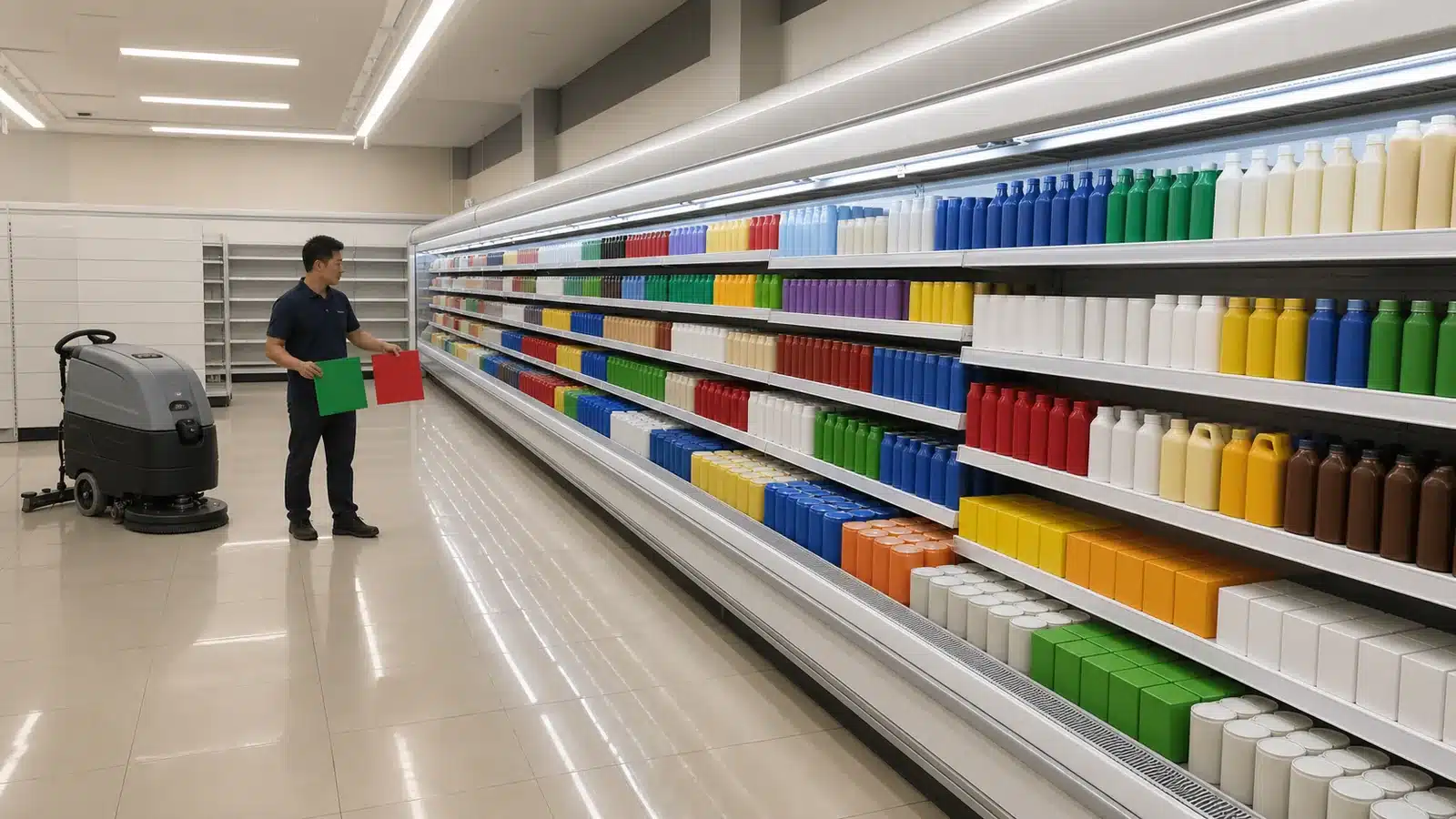
Measure the Actual Cleaning Machine Envelope
Record body, brush deck, steering, operator, hose, and service projections in working condition. For the open chiller cleaning machine clearance workflow, this checkpoint joins machine ID, overall envelope, brush or squeegee projection, and turning direction to a named status and responsible role.
Owner's Working Record
- machine ID: Locate the evidence for machine ID, then place it in the open chiller cleaning machine clearance record with responsibility and timing visible.
- overall envelope: Locate the evidence for overall envelope, then place it in the open chiller cleaning machine clearance record with responsibility and timing visible.
- brush or squeegee projection: Locate the evidence for brush or squeegee projection, then place it in the open chiller cleaning machine clearance record with responsibility and timing visible.
- turning direction: Locate the evidence for turning direction, then place it in the open chiller cleaning machine clearance record with responsibility and timing visible.
- operator position: Locate the evidence for operator position, then place it in the open chiller cleaning machine clearance record with responsibility and timing visible.
- cable or hose: Locate the evidence for cable or hose, then place it in the open chiller cleaning machine clearance record with responsibility and timing visible.
Failure path: Using the chassis width while the working attachment extends closer to the cabinet. Test the open chiller cleaning machine clearance sequence through machine ID, overall envelope, and brush or squeegee projection. A mismatch should remain attached to turning direction, not disappear inside a general comment.
Closeout point: The route review uses the complete working envelope. Close this open chiller cleaning machine clearance stage only when operator position, cable or hose, and survey photo support the same status.
Map Chiller and Aisle Projections
Identify shelf noses, kickplate, base, end panels, columns, bollards, and adjacent fixtures. For the open chiller cleaning machine clearance workflow, this checkpoint joins chiller line, shelf projection, base and kickplate, and end condition to a named status and responsible role.
Decision Fields
- chiller line: Treat chiller line as a decision field for open chiller cleaning machine clearance; preserve the observed value, its source, reviewer, and unresolved status.
- shelf projection: Treat shelf projection as a decision field for open chiller cleaning machine clearance; preserve the observed value, its source, reviewer, and unresolved status.
- base and kickplate: Treat base and kickplate as a decision field for open chiller cleaning machine clearance; preserve the observed value, its source, reviewer, and unresolved status.
- end condition: Treat end condition as a decision field for open chiller cleaning machine clearance; preserve the observed value, its source, reviewer, and unresolved status.
- column: Treat column as a decision field for open chiller cleaning machine clearance; preserve the observed value, its source, reviewer, and unresolved status.
- promotion fixture: Treat promotion fixture as a decision field for open chiller cleaning machine clearance; preserve the observed value, its source, reviewer, and unresolved status.
Reason for control: Drawing the cabinet as a flat wall and omitting the most exposed edge. The open chiller cleaning machine clearance reviewer uses chiller line to identify the item, shelf projection to confirm context, and base and kickplate to show responsibility. Any conflict stays linked to end condition.
Decision gate: The plan shows every fixed projection relevant to the route. The open chiller cleaning machine clearance decision cites column, records promotion fixture, and leaves floor transition open if follow-up remains.
Test the Swept Path
Observe forward travel, turns, reversing, and passing points under controlled conditions. For the open chiller cleaning machine clearance workflow, this checkpoint joins start position, turning point, closest approach, and reverse path to a named status and responsible role.
Handover Evidence
- start position: The open chiller cleaning machine clearance handoff names start position, where it was checked, who checked it, and what must happen next.
- turning point: The open chiller cleaning machine clearance handoff names turning point, where it was checked, who checked it, and what must happen next.
- closest approach: The open chiller cleaning machine clearance handoff names closest approach, where it was checked, who checked it, and what must happen next.
- reverse path: The open chiller cleaning machine clearance handoff names reverse path, where it was checked, who checked it, and what must happen next.
- operator sightline: The open chiller cleaning machine clearance handoff names operator sightline, where it was checked, who checked it, and what must happen next.
- spotter: The open chiller cleaning machine clearance handoff names spotter, where it was checked, who checked it, and what must happen next.
Review trigger: Assuming a machine that fits straight through can turn or reverse safely in the same aisle. When that trigger appears, the open chiller cleaning machine clearance owner checks start position against turning point, preserves closest approach, and routes reverse path to the proper authority.
Handover test: The tested route and limitations are documented without contact. The next open chiller cleaning machine clearance role receives operator sightline, spotter, and the current state of test result rather than a verbal assurance.
Separate Cleaning From Replenishment and Shopping
Choose a work window and exclusion method for the actual store. For the open chiller cleaning machine clearance workflow, this checkpoint joins cleaning window, trading status, replenishment schedule, and barrier or spotter to a named status and responsible role.
Traceable Records
- cleaning window: Link cleaning window to the physical open chiller cleaning machine clearance item; note evidence, custody, date, exception state, and authorized follow-up.
- trading status: Link trading status to the physical open chiller cleaning machine clearance item; note evidence, custody, date, exception state, and authorized follow-up.
- replenishment schedule: Link replenishment schedule to the physical open chiller cleaning machine clearance item; note evidence, custody, date, exception state, and authorized follow-up.
- barrier or spotter: Link barrier or spotter to the physical open chiller cleaning machine clearance item; note evidence, custody, date, exception state, and authorized follow-up.
- pedestrian diversion: Link pedestrian diversion to the physical open chiller cleaning machine clearance item; note evidence, custody, date, exception state, and authorized follow-up.
- machine staging: Link machine staging to the physical open chiller cleaning machine clearance item; note evidence, custody, date, exception state, and authorized follow-up.
Control risk: Running cleaning, shelf refill, and shopper traffic through the same constrained path. Use cleaning window and trading status to reconstruct this open chiller cleaning machine clearance event. If replenishment schedule conflicts with barrier or spotter, protect the affected item and name the reviewer.
Authorized release: The approved work window controls competing movements. Record the open chiller cleaning machine clearance outcome beside pedestrian diversion, machine staging, and supervisor; unresolved evidence keeps the stage open.
Protect Product and Cabinet Functions
Keep spray, debris, tools, and temporary items away from displayed stock and cabinet openings. For the open chiller cleaning machine clearance workflow, this checkpoint joins product protection, floor-care material, splash control, and shelf edge to a named status and responsible role.
Evidence to Capture
- product protection: For open chiller cleaning machine clearance, capture product protection at its source; connect product protection to an owner, current status, location, and date.
- floor-care material: For open chiller cleaning machine clearance, capture floor-care material at its source; connect floor-care material to an owner, current status, location, and date.
- splash control: For open chiller cleaning machine clearance, capture splash control at its source; connect splash control to an owner, current status, location, and date.
- shelf edge: For open chiller cleaning machine clearance, capture shelf edge at its source; connect shelf edge to an owner, current status, location, and date.
- kickplate: For open chiller cleaning machine clearance, capture kickplate at its source; connect kickplate to an owner, current status, location, and date.
- air opening: For open chiller cleaning machine clearance, capture air opening at its source; connect air opening to an owner, current status, location, and date.
Exception analysis: Treating the open display as ordinary shelving while floor work happens beside it. In the open chiller cleaning machine clearance file, compare product protection with floor-care material; use splash control and shelf edge to locate the break. Keep kickplate visible while the assigned role investigates.
Release evidence: The floor task closes with stock and visible cabinet areas reviewed under store procedure. For open chiller cleaning machine clearance, connect that result to air opening and post-clean observation, including any open owner and next review date.
Route Contact or Damage Evidence
Stop and document any strike, moved panel, unusual noise, or floor condition before reuse. For the open chiller cleaning machine clearance workflow, this checkpoint joins event time, machine and cabinet ID, contact location, and photographs to a named status and responsible role.
Owner's Working Record
- event time: Locate the evidence for event time, then place it in the open chiller cleaning machine clearance record with responsibility and timing visible.
- machine and cabinet ID: Locate the evidence for machine and cabinet ID, then place it in the open chiller cleaning machine clearance record with responsibility and timing visible.
- contact location: Locate the evidence for contact location, then place it in the open chiller cleaning machine clearance record with responsibility and timing visible.
- photographs: Locate the evidence for photographs, then place it in the open chiller cleaning machine clearance record with responsibility and timing visible.
- product status: Locate the evidence for product status, then place it in the open chiller cleaning machine clearance record with responsibility and timing visible.
- service route: Locate the evidence for service route, then place it in the open chiller cleaning machine clearance record with responsibility and timing visible.
Failure path: Pushing a panel back into place and continuing without preserving the event. Test the open chiller cleaning machine clearance sequence through event time, machine and cabinet ID, and contact location. A mismatch should remain attached to photographs, not disappear inside a general comment.
Closeout point: The affected area remains controlled until the responsible role releases it. Close this open chiller cleaning machine clearance stage only when product status, service route, and release authority support the same status.
Open Chiller Aisle-Cleaning Machine Clearance and Store Scheduling Control Matrix
This open chiller cleaning machine clearance matrix keeps each checkpoint beside its own evidence and release question. Use a separate row whenever the physical item, location, responsible role, or decision status changes.
| Open Chiller Cleaning Machine Clearance checkpoint | Evidence for this decision | Question before movement |
|---|---|---|
| Measure the Actual Cleaning Machine Envelope | machine ID, overall envelope, brush or squeegee projection, and turning direction | the route review uses the complete working envelope. |
| Map Chiller and Aisle Projections | chiller line, shelf projection, base and kickplate, and end condition | the plan shows every fixed projection relevant to the route. |
| Test the Swept Path | start position, turning point, closest approach, and reverse path | the tested route and limitations are documented without contact. |
| Separate Cleaning From Replenishment and Shopping | cleaning window, trading status, replenishment schedule, and barrier or spotter | the approved work window controls competing movements. |
| Protect Product and Cabinet Functions | product protection, floor-care material, splash control, and shelf edge | the floor task closes with stock and visible cabinet areas reviewed under store procedure. |
| Route Contact or Damage Evidence | event time, machine and cabinet ID, contact location, and photographs | the affected area remains controlled until the responsible role releases it. |
Open Chiller Aisle-Cleaning Machine Clearance and Store Scheduling Release Checklist
- Retain machine ID while the open chiller cleaning machine clearance owner closes measure the actual cleaning machine envelope.
- Retain chiller line while the open chiller cleaning machine clearance owner closes map chiller and aisle projections.
- Retain start position while the open chiller cleaning machine clearance owner closes test the swept path.
- Retain cleaning window while the open chiller cleaning machine clearance owner closes separate cleaning from replenishment and shopping.
- Retain product protection while the open chiller cleaning machine clearance owner closes protect product and cabinet functions.
- Retain event time while the open chiller cleaning machine clearance owner closes route contact or damage evidence.
Questions About Open Chiller Aisle-Cleaning Machine Clearance and Store Scheduling
Why separate open chiller cleaning machine clearance from a general checklist?
A dedicated record keeps actual machine envelope beside chiller projections, while swept path and turning test remain attributable to their owners. A broad checklist usually loses that sequence.
What evidence should exist at the opening gate?
Use machine ID; overall envelope; brush or squeegee projection; turning direction; operator position; cable or hose; survey photo as the opening evidence set for open chiller cleaning machine clearance. Resolve missing revisions or unclear ownership before the operation moves forward.
How is an exception contained?
Treat this condition as the stop trigger: running cleaning, shelf refill, and shopper traffic through the same constrained path. The open chiller cleaning machine clearance owner records the location, protects the item from normal use, and routes the question to the authorized role.
Are fixed limits supplied here?
They are not. No universal aisle width, machine turning radius, impact tolerance, floor-care method, or chiller clearance is claimed. The controlled order, selected model, approved drawing or survey, and assigned reviewer govern the actual open chiller cleaning machine clearance release.
Related Product or Reading
- Multideck open chiller range: keeps the recommendation tied to the verified product scope and exact equipment or material identity
- Open Chiller Water on the Floor: Store Checks Before Service: covers the nearest adjacent buyer task without duplicating the workflow in this article
- Straight-glass deli showcase counter: is a separate service-counter option for staffed prepared-food presentation rather than open-shelf merchandising
Prepare the Review File
Send actual machine envelope, chiller projections, swept path, turning test, shopper exclusion, replenishment schedule, impact exception record to XCCOLD. For this open chiller cleaning machine clearance request, those records let the team review the selected open-front multideck chiller workflow against the buyer task and verified product scope.